THE SAASPOCALYPSE IS REAL
A health insurer vibecodes away a $600K Salesforce bill, HubSpot turns the CRM into an agent control plane, Anthropic hires a human to pick up the phone & Ramp’s first SDR becomes its SVP
The SaaSpocalypse everyone wrote off six months ago just showed up on a podcast, holding a $600,000 receipt.
This issue is about what dies and what quietly gets stronger. A health insurer killed its Salesforce contract with a CRM it vibecoded in two months. HubSpot answered by turning the CRM into the place you build and run your agents. Anthropic, the company behind Claude, posted a job for a human to pick up the phone. And Ramp’s first-ever SDR just became its SVP of Sales. Read them together and the pattern is hard to miss: the per-seat license is dying, but the infrastructure everyone already trusts and the people who understand the customer are getting promoted, not replaced. The smartest model isn’t winning. The distribution already in the building is. Let’s get into the trenches.
A $600K Salesforce contract, killed by a CRM they vibecoded in two months💀
A health insurer just deleted a $600,000-a-year Salesforce bill and replaced it with a CRM its own team vibecoded in two months.
On the 20VC podcast, Curative CEO Fred Turner got asked point-blank if he thinks SaaS is dying. “Yes,” he said. The proof: Curative canceled its $600K/year Salesforce contract and swapped in an internal CRM built in eight weeks. And that’s just the start, Turner plans to cut about 80% of Curative’s SaaS spend this year and move it to AI.
The backdrop matters more than the soundbite. This is the same “SaaSpocalypse” that knocked 20–50% off Salesforce, Workday, ServiceNow, DocuSign, Adobe and Asana earlier in 2026, when investors bet AI coding tools would let buyers build instead of buy. Salesforce’s Marc Benioff hit back with the “SaaS-quatch”: demand is “incredible,” 150,000 companies still run the platform, and even Anthropic runs its GTM on Salesforce. Both are true, and that’s the point.
The murder weapon wasn’t code, it was ROI. Curative’s contract-negotiation agent, “Gwen,” closes a provider deal for about $70 that used to cost $1,500–$2,000 with humans, so the team runs 10x the volume now and is chasing 20x. Its Anthropic bill has 6x’d every month, from tens of thousands to millions, and Turner says the math still works even if Anthropic 5x’d its prices. That’s your buy signal: if you sell AI, every fat SaaS renewal on a prospect’s books is your pipeline, as long as you prove that ROI before the renewal date. One honest catch, Turner admits maintenance is “the most challenging piece”, rip out the vendor and you inherit everything it used to carry.
Damian’s insight:
The SaaSpocalypse isn’t a stock story, it’s a sales story. Software didn’t lose to a smarter model, it lost to a CEO who could finally see the ROI, $70 versus $2,000, 10x the volume, and act on it in two months instead of two years. Distribution and switching costs protected Salesforce for twenty years, and the moment ROI got big enough to beat them, a $600K contract died live on a podcast. So stop selling features and start hunting line items, find the bloated contract, prove the $70 version, let the renewal date close the deal. ROI is the murder weapon.
HubSpot’s answer to the SaaSpocalypse: make the CRM the agent 🧩
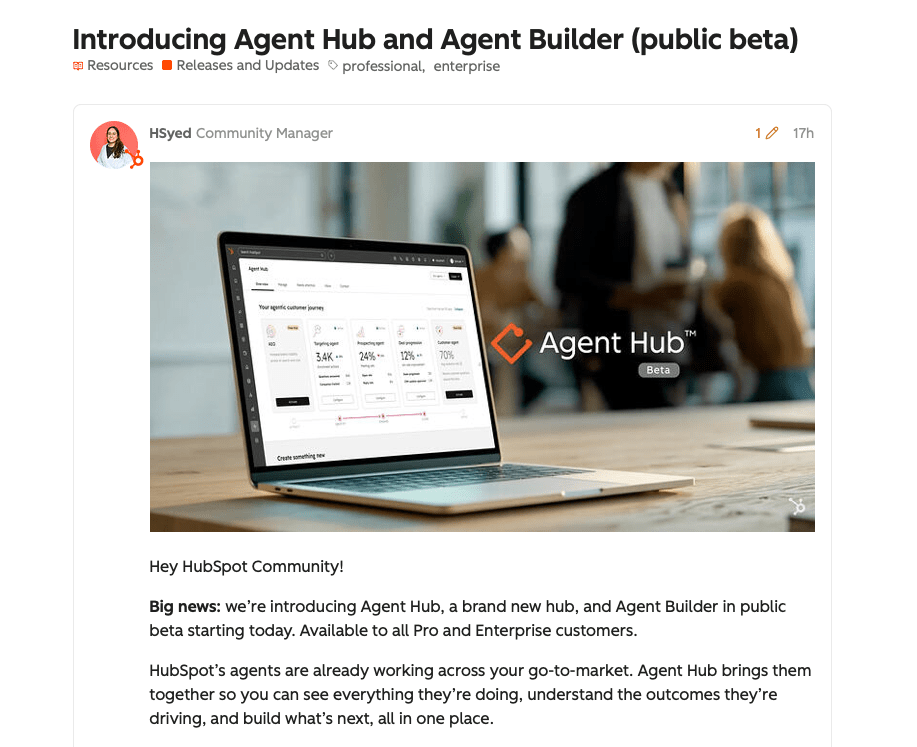
While one CEO rips the CRM out, HubSpot is betting the CRM becomes the one thing you can’t vibecode around, the place your agents live.
On July 23, HubSpot shipped Agent Hub and Agent Builder into public beta for every Pro and Enterprise customer. Agent Hub is one screen showing every AI agent running your go-to-market, sorted by outcome, build demand, win deals, delight customers, scale growth, each card with live status and results, idle ones flagged with a single button to switch them on. Agent Builder lets you spin up custom agents just by describing them to Breeze in plain language.
Here’s the line that matters: it’s “built on the data already in your CRM. No separate tool, no field mapping, and no technical team required.” Your contacts, deals, calls and buying signals are already there, “no setup, no migration, no starting from scratch.”
Put that next to story one and the strategy clicks. Curative’s pain is that after ripping Salesforce out, it now owns all the plumbing, and maintenance is the hardest part. HubSpot sells the opposite: don’t rebuild the system of record, build your agents on top of it. The CRM stops being a place you store contacts and pay per seat, and becomes the control plane where humans and agents run GTM off the same data. That’s the moat vibecoding can’t cross, not features, but the trusted data and the workflows your whole team already lives in.
Damian’s insight:
This is the CRM’s real second act. The per-seat model is a dead man walking, you won’t pay by the human head when half your reps are agents. But the CRM as the foundational layer only gets stronger. It’s been in every sales org for years, everyone knows how to drive it, and it holds the one thing an agent is useless without: clean, trusted data about your customers. Whoever turns the CRM into the place you manage customers, reps and agents owns GTM for the next decade. Curative proves the license is killable. HubSpot proves the layer isn’t. Distribution beats the model, again.
Anthropic is hiring a human to do the outbound its own AI could fake 📞

Too many SDRs are hiding behind their inbox, and quietly asking to be replaced by AI.
Here’s the tell of the whole cycle. Anthropic, the company behind Claude, the model half the “AI SDRs” on the market run on, just posted a job for a human Business Development Representative in Seoul. Not an agent. A person with 2–3 years’ experience, fluent in Korean and English, who will “maintain full ownership of pipeline generating activities” and “outbound against strategic prospects to generate high-intent opportunities.” Required tools: Salesforce, HubSpot, SQL.

Now put that next to the phones. Cognism analyzed 200,000+ cold calls: the industry success rate climbed back to 2.7%, its own team hit 11.3%, and it now takes 1.55 dials to reach a prospect, down from 2.9. The reason is almost funny, inboxes are so stuffed with AI-written sequences that the phone became the most reliable channel again, and being the first rep in front of a buyer makes you 74% more likely to close. The SDR burying that same buyer under one more automated email isn’t scaling, they’re turning themselves into a commodity.
So the role isn’t dying, it’s splitting. One rep fires 10,000 emails nobody opens and calls it modern, the other picks up the phone, leads with a signal, qualifies with judgment, and owns the pipeline, the exact human Anthropic just wrote a job description for. If that’s you, the move is simple: get off the send button and onto the phone (the data says Tuesday and Thursday, 10–11am), lead with a signal instead of a template, learn the CRM cold because Anthropic isn’t asking for Salesforce, HubSpot and SQL by accident, and protect the one thing no agent fakes, the live qualification call where a real opportunity is born.
See Cognism’s cold calling data here!
Damian’s insight:
The reps sweating over AI are the ones who already turned themselves into software, a send-and-pray sequence engine. Of course that gets replaced, it was a robot before the robots showed up. The rep who owns the phone, pulls signals off the CRM, and runs the human qualification call is doing the exact job Anthropic just posted. AI didn’t kill the SDR. Email did. Pick up the phone.

Ramp’s first SDR just became its SVP of Sales 🧗

Max Freeman joined Ramp as its first SDR in 2020. Six years later he runs the whole GTM org, and he never left.
He didn’t dial cold for a year and bounce. He stayed, through AE, customer support, SDR manager and growth, then built, in his words, “5 of our critical go-to-market functions.” Head of New Business Development, Head of MidMarket, Head of Sales, VP, and as of June 2026, SVP of Sales, running acquisition, service and growth across the whole customer lifecycle. Six years, one logo, first dialer to the top of the org.
The through-line isn’t hustle, it’s the customer. His MidMarket team “partnered with finance and accounting leaders to deliver financial impact and operational efficiencies”, read that again, Ramp doesn’t pitch software features, it shows a CFO a smaller bill and fewer wasted hours. Max climbed by getting fluent in his buyer’s numbers, the same ROI language Curative used to kill its $600K Salesforce contract in story one.
So what do you steal from it? Own the whole motion, the person who’s been SDR, AE, support and manager is the one who ends up running GTM. Sell the outcome, not the product, fluency in your buyer’s numbers is the skill that lasts while tools change. And stay, in an era of 18-month job hops, Max’s edge is six years of customer depth in one place. The SDR chair isn’t a dead end, for Max it was the first rung to SVP.
Damian’s insight:
Here’s what the SaaSpocalypse can’t touch. You can vibecode a CRM in two months and switch an agent on in one click, but you can’t vibecode six years of understanding a CFO’s numbers. Max didn’t rise by out-dialing anyone, he rose by understanding the customer a little better every year and refusing to leave before it compounded. That’s the whole thesis of this issue in one career: as the software layer gets cheap, the human who owns the customer is worth more, not less. Tools are downloadable. Perseverance and customer understanding aren’t.