Go-to-Market Strategy: how to launch a B2B product without burning your budget

The product is ready, the website is live, the campaign has started. Three months later the CRM shows a few dozen leads, a handful of demos and zero signed contracts. The board asks whether the problem is the product, marketing or sales. Usually the answer is all three at once, because nobody decided upfront who the new product is for, at what price and through which channel it should be sold.
That is what a go-to-market strategy is for. It is a set of decisions that turns a product launch from a one-off campaign into a repeatable way of winning customers. In this article we go through every element in turn: market research, segment choice, value proposition, price, channels, promotion, the sales team and the launch timeline. Each one is shown from the perspective of what happens next in the pipeline.
A good go-to-market strategy has one goal: first deals faster and cheaper than if the company had to learn the market through its own mistakes.
GTM strategy and market entry: when you need one and when a sales plan is enough
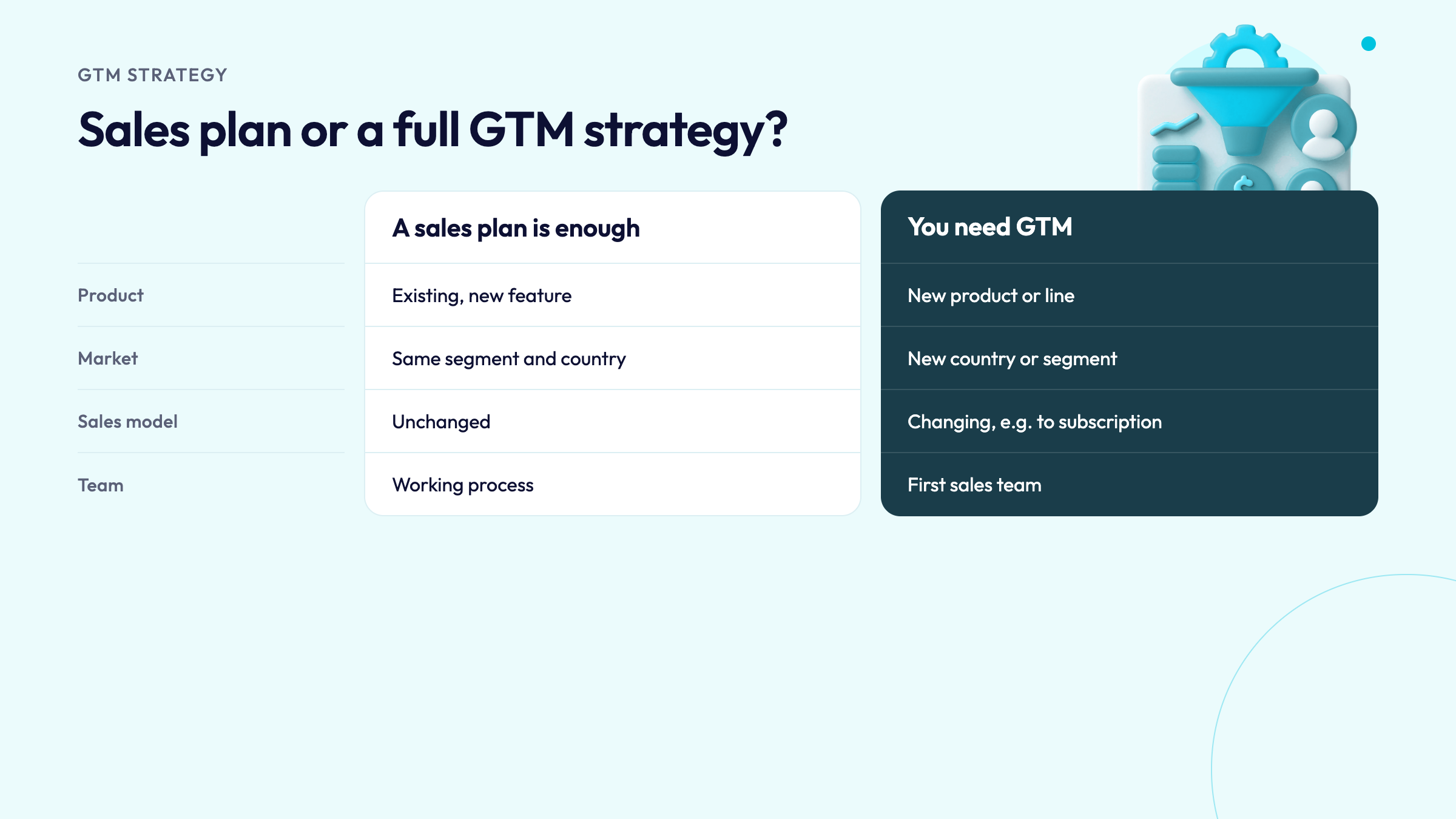
Not every change calls for a full GTM. If a company adds a feature to a product it already sells to its existing customer base through the same channel, a sales and communication plan is enough. A GTM strategy is needed when at least one of three things changes: the product, the market or the way you sell. Typical situations:
- a new product or product line,
- entering a new country or a new segment,
- moving from project-based sales to a subscription model,
- launching the first sales team in a startup.
A GTM strategy for a startup looks different from one for a company launching another product line. A startup has no brand, no data and no team, so its GTM is largely a series of tests.
An established company has a customer base and channels, but it risks the new product getting lost in the old process, because salespeople prefer to sell what they know. In both cases the strategy has to answer the same questions:
- which market are we entering,
- who buys,
- why would they buy from us,
- at what price,
- how will we reach them.
The most common mistake is treating GTM as a document. A deck appears with TAM, SAM and SOM, personas and a funnel, the board approves it and that is the end of it. A go-to-market strategy is only useful when every decision has an owner and a date when it gets checked.
Market strategy sets the direction, and sales strategy translates it into who the reps call on Monday morning. When these two layers drift apart, marketing generates leads from a different segment than the one sales knows how to close.
That is why strategy and marketing cannot be built separately. Sales and marketing have to start from the same assumptions about the customer and the same definition of success. A market strategy for a new product that does not guarantee this ends in arguments about lead quality instead of results.
In this sense a GTM strategy is simply a shared plan for product, marketing and sales, with a measurable goal for the first 90 days and the first two quarters. If someone in the company ties these areas together operationally, that is the role we describe in the article who is a GTM engineer.
Market research and competitive analysis: before you spend the first euro on a launch
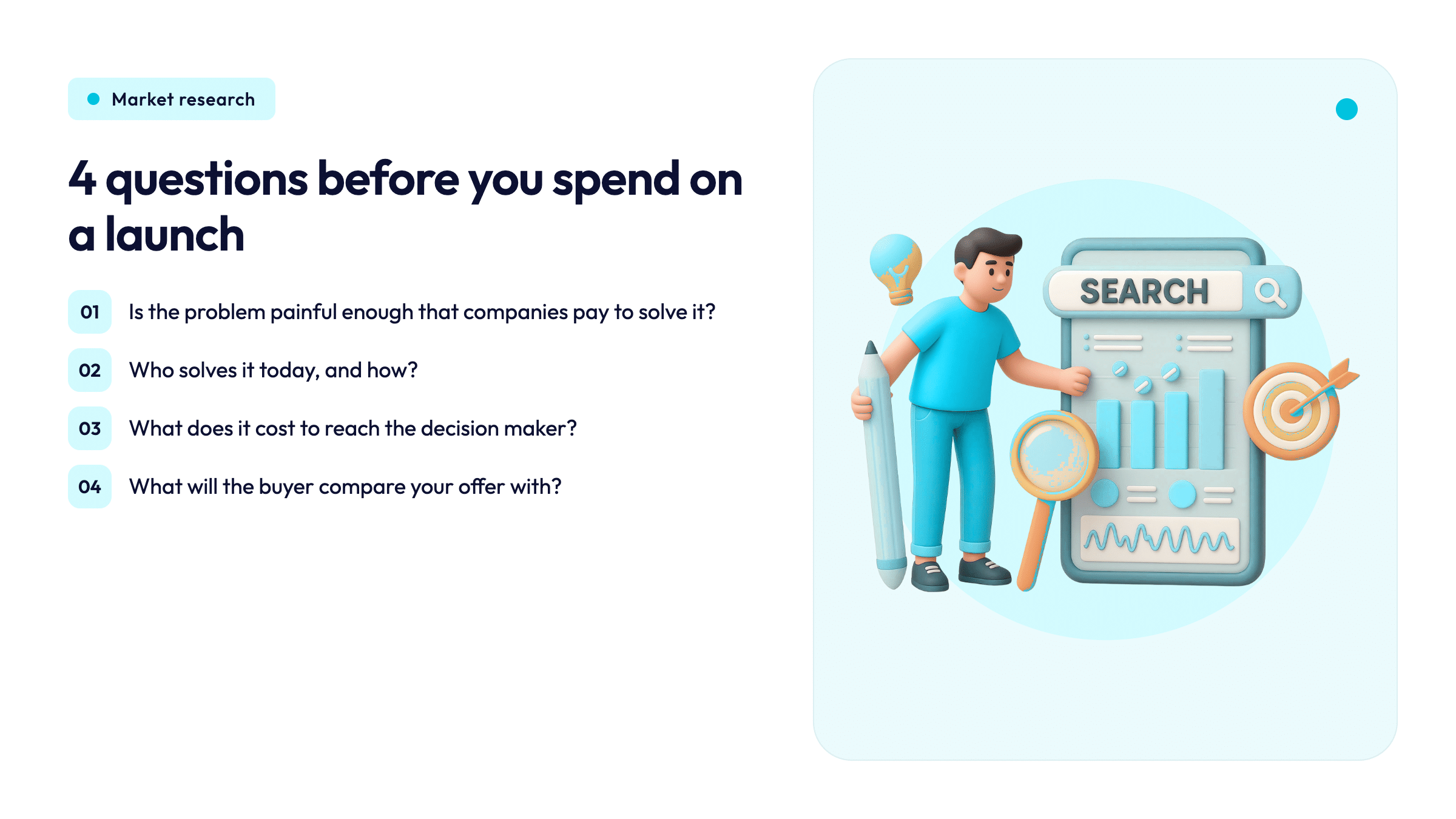
Market research before a launch should answer a few questions that drive concrete decisions:
- Is the problem you solve painful enough that companies pay to fix it?
- Who solves it today, and how?
- What does it cost to reach the decision maker?
If your market research does not change any of these answers, it was a waste of time.
The most valuable source is conversations. Twenty or thirty conversations with people from the target segment tell you more than an industry report, because they show the language buyers use to describe the problem and what they have already tried. Secondary data, such as reports, statistics and industry forums, helps estimate market size, but rarely explains why someone will buy. A GTM strategy based only on secondary data usually overestimates demand.
Competitive analysis has a different purpose than comparing feature tables. The point is to understand what the buyer will compare your offer with. Often the biggest competitor turns out to be a spreadsheet, an intern or the decision to “leave things as they are”. If the competition is the status quo, your messaging has to show the cost of doing nothing. Comparison with another tool comes second.
The conclusions from competitive analysis directly shape how you prepare the product launch, what price you set and who you call first.
SWOT and PEST in practice: what they mean for your decisions
SWOT analysis and PEST analysis have a bad reputation, because they usually end up as a slide with four boxes that nobody looks at again. The problem is how they are used. A good SWOT analysis ends with a list of decisions: which weakness you cannot hide from the buyer and must address in the offer, which opportunity you use in the first quarter and which one you postpone. If the analysis does not change anything in the plan, do a shorter version or skip it.
PEST analysis is particularly useful when entering a new country or a regulated industry. A change in regulation, the budget cycle in the public sector or the economic situation in the customer’s industry can add a quarter to the sales cycle regardless of how good the product is. You run a PEST analysis to build these factors into the timeline and the revenue forecast.
In this sense a market strategy also covers things the company cannot control but has to plan for. A well-built strategy uses these conclusions when choosing the segment, which we cover next. Only on this foundation does a go-to-market strategy stop being a collection of assumptions.
Target market and market segmentation: which market you can win
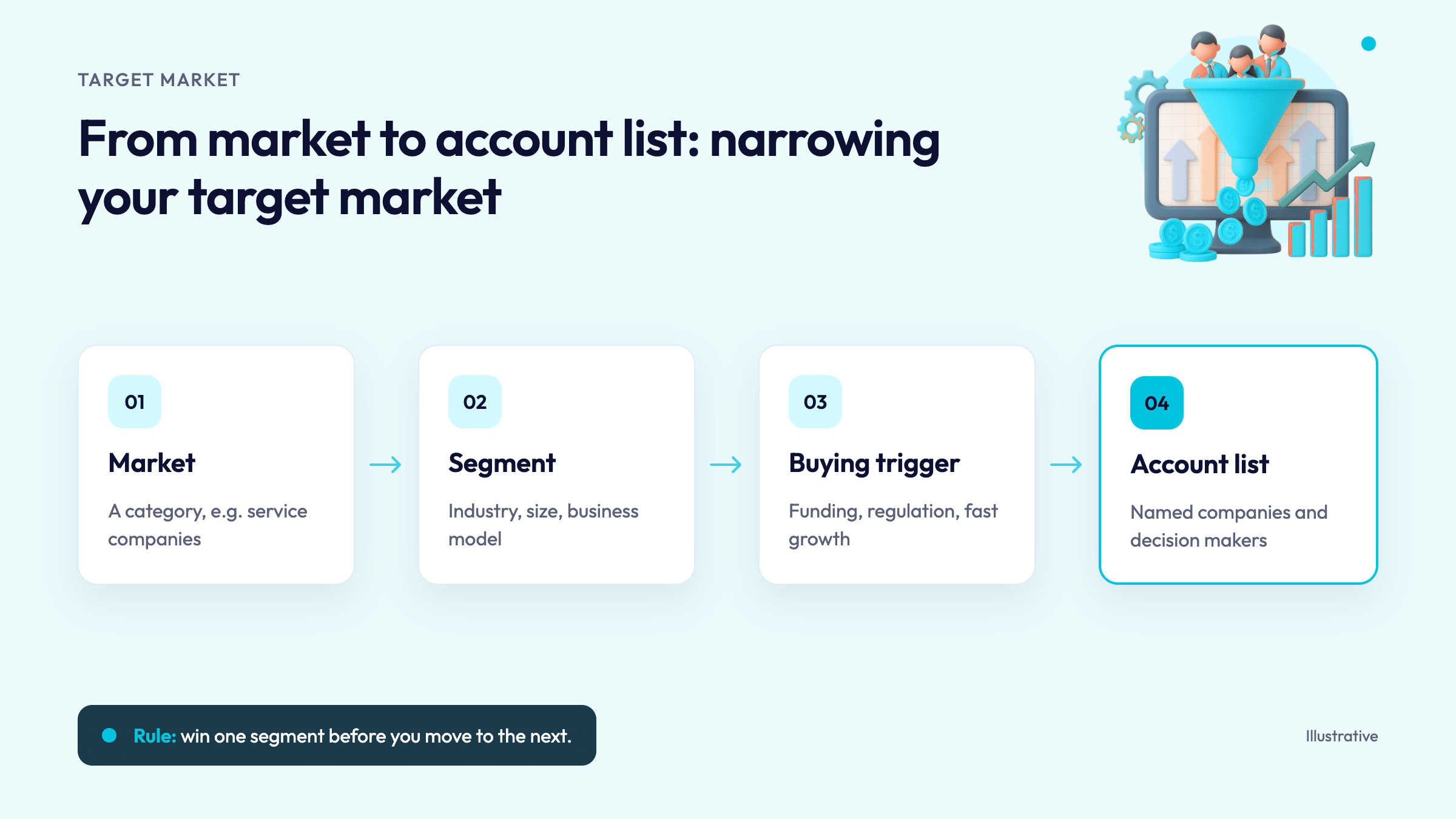
The most common answer to “who is your customer” is: small and medium-sized businesses. That is a statistical category. A real target market looks very different. In GTM the target market has to be narrow enough to build a list of companies, write a message that hits their specific problem and calculate what it costs to reach them.
Market segmentation in B2B divides the market by characteristics that affect the buying decision:
- industry and company size,
- business model,
- process maturity and existing tools,
- a buying trigger, such as a new funding round, a regulatory change or fast team growth.
Good market segmentation tells you in which segment the problem is most painful and the cost of reaching buyers is lowest. Often it is a narrower slice of the market than the team would like. An early-stage GTM strategy is about winning one segment before moving to the next. Good examples of market strategy in B2B almost always start this way.
Choosing a single segment at the start feels risky, because it limits the addressable market. In practice it gives you three advantages:
- Specific messaging, because you speak the language of one industry.
- References that work, because the next customers see companies similar to themselves.
- A shorter cycle, because the team learns the objections faster.
Your strategy should therefore clearly name the starting segment and the criteria for moving to the next one. A market strategy that tries to serve everyone from day one usually serves nobody well.
The next step is segmenting by readiness to buy. Within the same segment there are companies that have the problem now and those that will have it in a year. The customers you target first should belong to the first group. In practice, a target market is a list of accounts, not a demographic description. A GTM strategy without such a list is hard to translate into the daily work of sales.
Target audience, ICP and buyer personas: who buys and who signs
The ICP, or ideal customer profile, describes the company: industry, size, model, situation. Buyer personas describe the people inside that company. In B2B the distinction matters, because the decision rarely depends on one person:
- The user feels the problem.
- Their manager owns the budget.
- Procurement negotiates the terms.
- IT or legal can block the rollout at the last minute.
Good buyer personas do not have names and hobbies. They describe:
- the goals this person is measured on,
- their concerns about change,
- where they get information,
- the criteria they use to evaluate a vendor.
Strategy and the customers you serve have to be aligned: if your messaging is written for the user but the decision is made by the CFO, the deal will stall at budget approval. Well-described personas tell your go-to-market strategy who to approach first and with what. We cover the ICP and its impact on channel choice in the article on customer acquisition channels in GTM.
Value proposition: why the customer should change what they do today
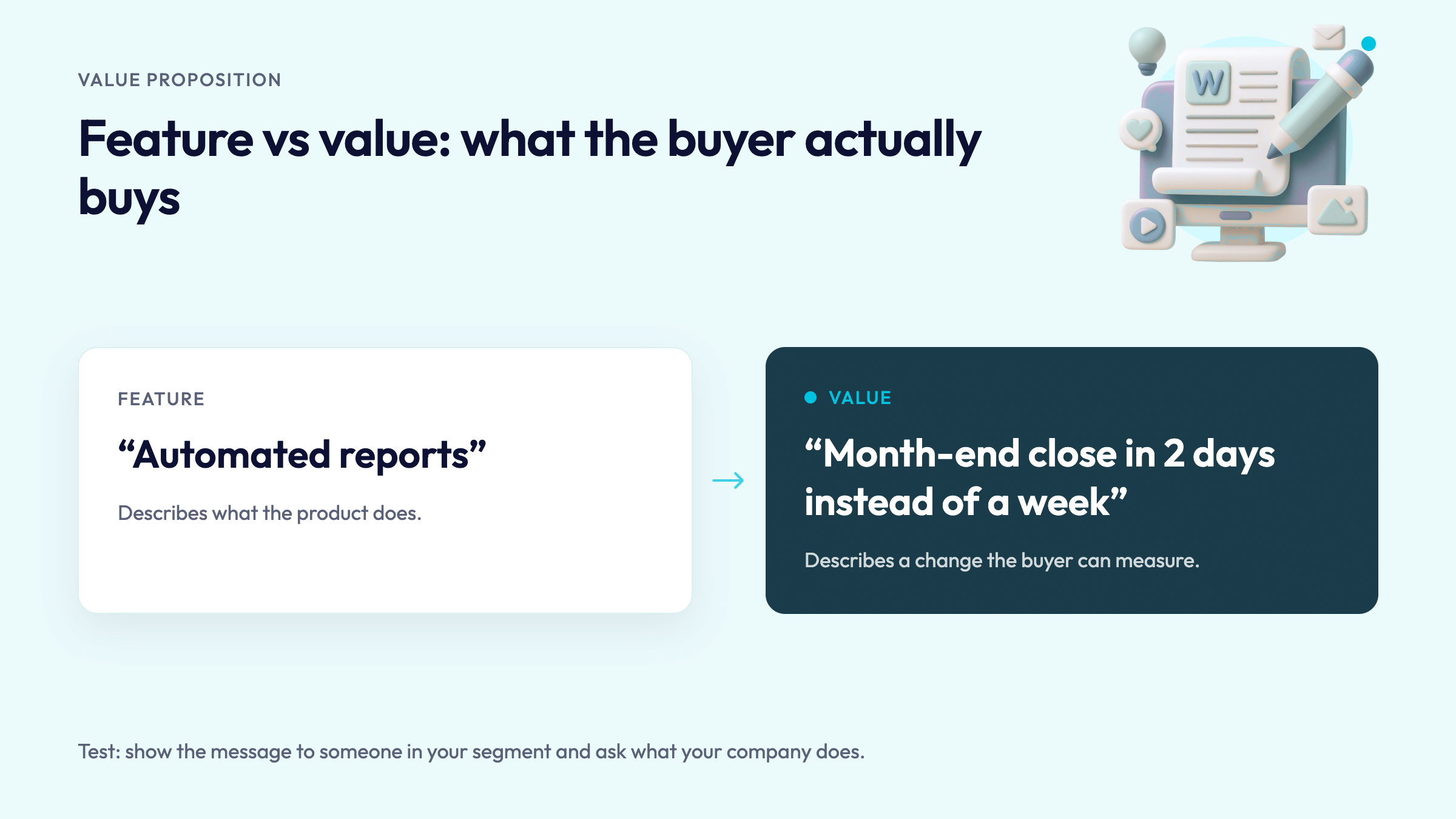
In B2B, the value proposition answers the question the buyer asks after every presentation: why should I change anything? That is why a good value proposition describes the change the customer will feel, not a list of features. “Automated reports” is a feature. “Month-end close in two days instead of a week” is value a CFO can measure.
A practical test of your value proposition is simple. Give it to someone from your target segment and ask what your company does and why they should talk to you. If the answer is vague, so is your message. What you promise has to match what the product actually delivers in the first weeks of use.
A promise without substance raises conversion to demo and lowers it at signature, and later at renewal. In B2B the market is smaller than it seems, and stories like that spread fast.
Product strategy and messaging often develop separately. The product team builds features for the most demanding customers while marketing communicates the product to everyone. Both should start from the same starting segment, otherwise the new product ends up too simple for large companies and too complex for small ones.
In the same way, product and strategy have to address the same objections: if buyers are afraid of a long rollout, then the rollout is part of the value proposition, not just a step after the sale.
For service companies this logic works even more strongly. The services you sell should be described through results, because a service is invisible before purchase. Customers who have already bought give you the best material: their own words about results are more convincing than any slogan.
Your case studies should use exactly that language. A go-to-market strategy without a clear value proposition means every salesperson describes the product a little differently.
Price and pricing strategy: how price affects the speed of sales
In GTM, price means much more than the number on the invoice. It decides who can buy without board approval, how long the sales cycle takes and what kind of team you need for sales to be profitable. A product priced at a few hundred a month cannot carry a salesperson who runs every deal through four meetings. A product priced at a few hundred thousand a year will not sell through a website form.
Your pricing strategy should therefore follow from your sales model, not only from costs or what others in the market charge. A few questions to ask before setting a price:
- Up to what amount can a decision maker in your target segment sign on their own?
- What will the buyer compare the price with: a competitor’s tool, a full-time hire, the cost of a mistake?
- What is your customer acquisition cost (CAC) in the planned channel, and will the margin cover it?
A GTM strategy that does not answer these questions risks every signed deal being loss-making.
The second decision is the price structure: per user, per volume, per module or flat fee. Each one changes the sales conversation:
- Per-user pricing is simple, but companies limit the number of seats and the product spreads more slowly.
- Volume-based pricing grows with the customer, but is harder to predict in a budget.
Test your pricing strategy with the first customers and adjust it before the price list goes on the website. A price that is easy to raise reflects value the customer is sure of. Packages should match segments rather than the internal structure of features.
The same strategy decides what goes into the basic version and what the customer pays extra for. A product with unclear pricing adds a round of questions to every conversation, which the salesperson has to pass on to someone else.
Freemium, trial or sales-led from the first call
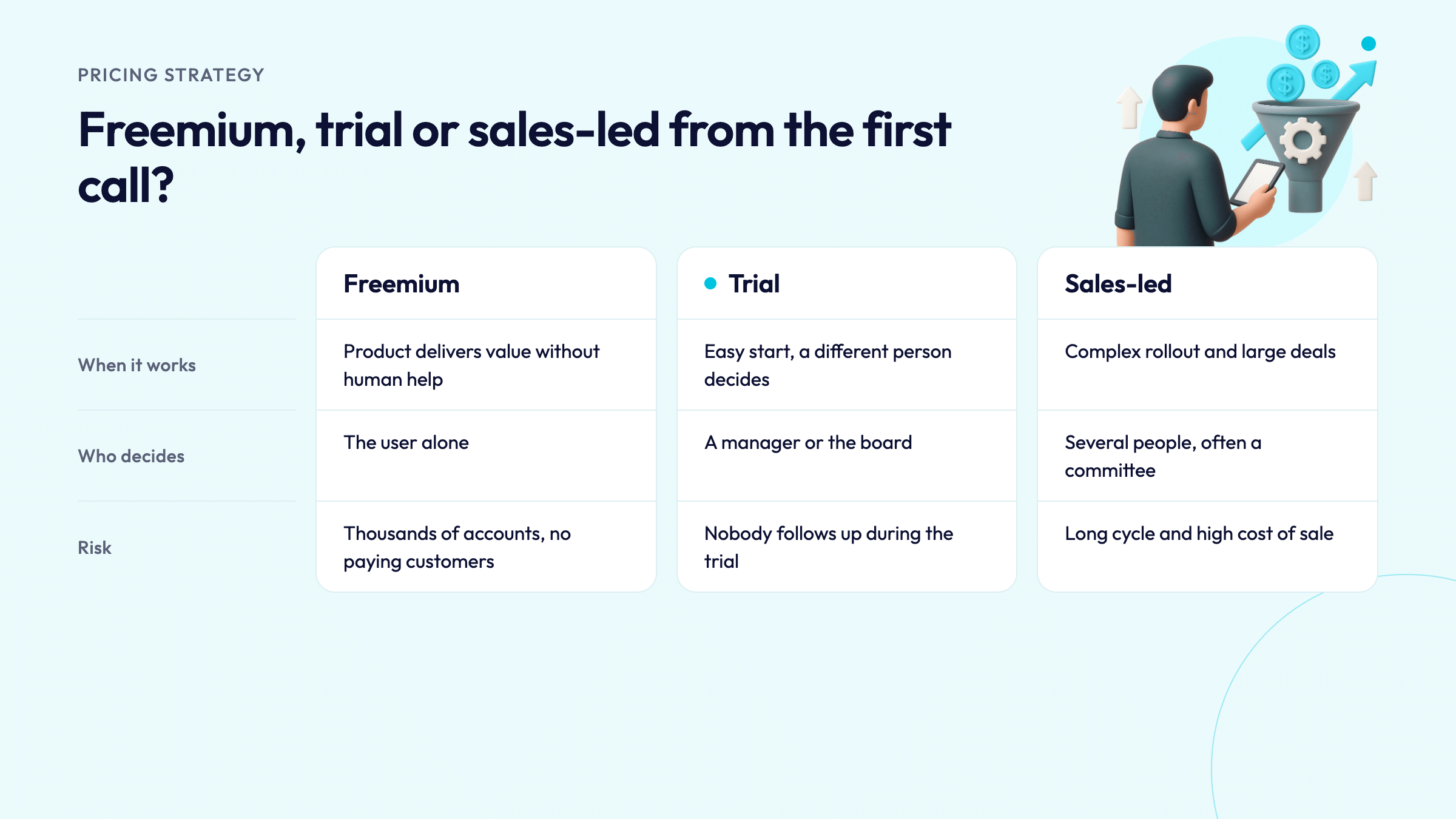
A freemium model works when the product delivers value without human help and the user can start on their own, without their manager’s approval. Acquisition cost is then low, and sales begins when the company grows and needs more. A freemium model for a product that requires implementation, integration or process change ends with thousands of accounts that lead nowhere.
A time-limited trial fits in the middle: the product is fairly easy to set up, but the decision is made by someone other than the user. A trial does, however, need someone who will contact the company during the test and guide it to a decision. Sales-led selling from the first call, with no free version, is natural for complex rollouts and large deals. Choosing between them is a strategic decision.
A freemium model chosen only because “the best companies do it” can eat the infrastructure and support budget before the first paying customer appears. In your go-to-market strategy, record this choice as a hypothesis to review after the first quarter.
Place: sales and distribution channels in B2B
In the marketing mix, place in B2B is the question of how the product reaches the customer and who runs the transaction. Sales and distribution channels are usually a combination of several models:
- direct sales through your own team,
- self-serve sales through the website,
- partners, integrators and resellers,
- app platforms and directories.
The most common mistake at launch is opening all channels at once. Each requires different skills, materials, contracts and metrics. Five channels run half-heartedly give you five samples that are too small to learn from. A GTM strategy for the first two quarters should have one main channel and at most one test channel.
How do you choose a channel? Match it to the price and the complexity of the decision:
- High deal value and a long cycle: direct sales.
- Low price and a simple product: self-serve, possibly supported by inside sales.
- A market where purchases go through trusted advisors: partners, even if it means sharing margin.
Your strategy should also account for how long it takes to build a channel: partners need training and several months before they bring the first deals.
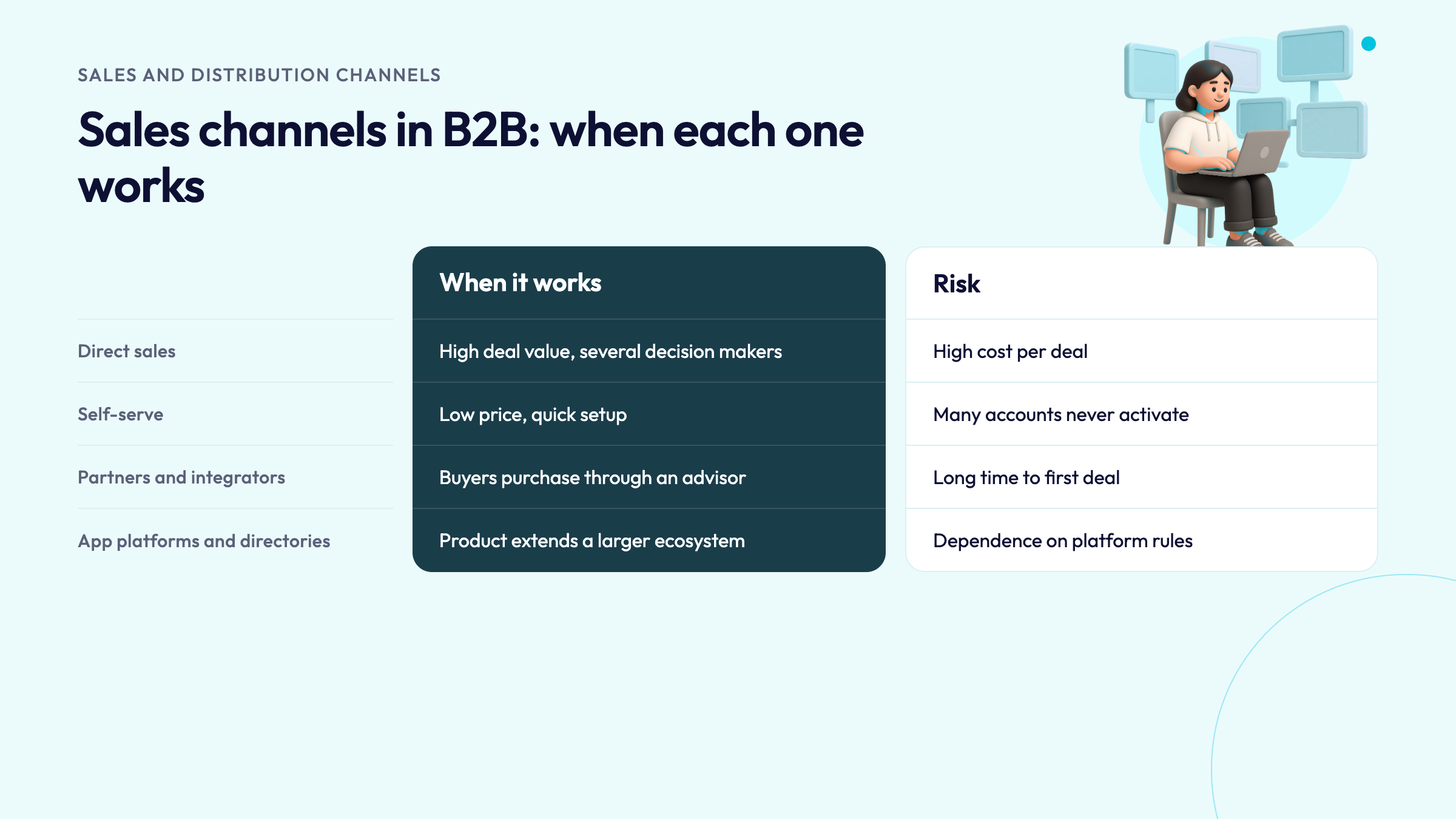
Partner messaging and your own have to complement each other. If an integrator sells your product as part of its own implementation, your messaging should show what the integrator gains, alongside the benefits for the end customer. It helps to put the sales and distribution channels in a simple decision table:
| Channel | When it works | What you need | Risk |
|---|---|---|---|
| Direct sales | high deal value, several decision makers | sales reps, process, materials | high cost per deal |
| Self-serve | low price, quick setup | in-product onboarding, online payments | many accounts never activate |
| Partners and integrators | buyers purchase through an advisor | partner program, training, margin | long time to first deal |
| App platforms and directories | the product extends a larger ecosystem | integration, listing, reviews | dependence on platform rules |
A go-to-market strategy that chooses its channel deliberately also makes budget and hiring easier to plan. A GTM strategy with one main channel lets you judge within a quarter whether the model works.
Promotion and brand awareness: inbound marketing strategy or outbound
Promotion is the fourth element of the marketing mix, and usually the one that gets the most money. In B2B at launch, the key question is: do you have time to wait for the market to come to you?
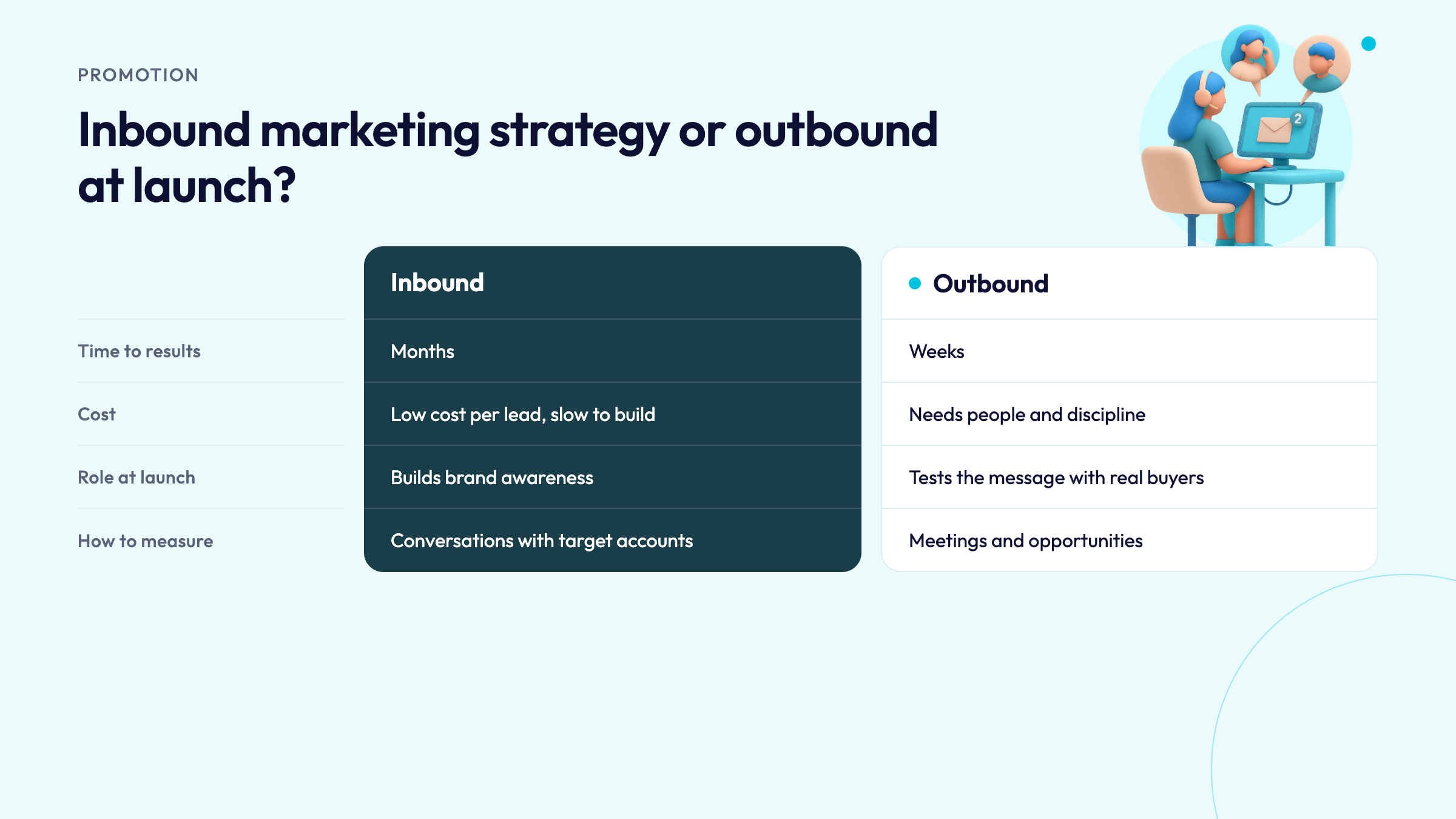
An inbound marketing strategy, meaning content, SEO, webinars and presence in industry media, builds brand awareness and attracts customers who are already looking for a solution. It delivers high-intent leads at a low unit cost, but results take months. A new brand with no track record that relies only on inbound can go two quarters with nothing to sell into.
Outbound, meaning direct outreach to selected companies backed by solid prospecting, gets conversations started faster and lets you test your message with real buyers, but it needs people and discipline.
In practice the right mix depends on your stage. At launch, outbound serves as fast validation: does the value proposition land, which segment responds, what objections come up. What you learn from these conversations feeds the content that builds inbound over the following quarters. Strategy and marketing have to work in a loop, and the marketing plan has to allow for the first content being revised after the first conversations.
Promotion in GTM is measured by engagement from the right companies. Reach on its own says little. Customer engagement from accounts on your target list tells you more than thousands of impressions. An early-stage marketing strategy should have a goal expressed in conversations and sales opportunities. Ask what your marketing strategy is and how you will measure it before the first campaign.
The number of marketing-qualified leads (MQLs) is a supporting metric, because an MQL that never talks to a salesperson does not pay invoices. A go-to-market strategy that measures marketing only on MQLs often ends in arguments about lead quality. A GTM strategy that holds both teams to the same result avoids that argument.
Marketing plan vs company marketing strategy in a GTM model
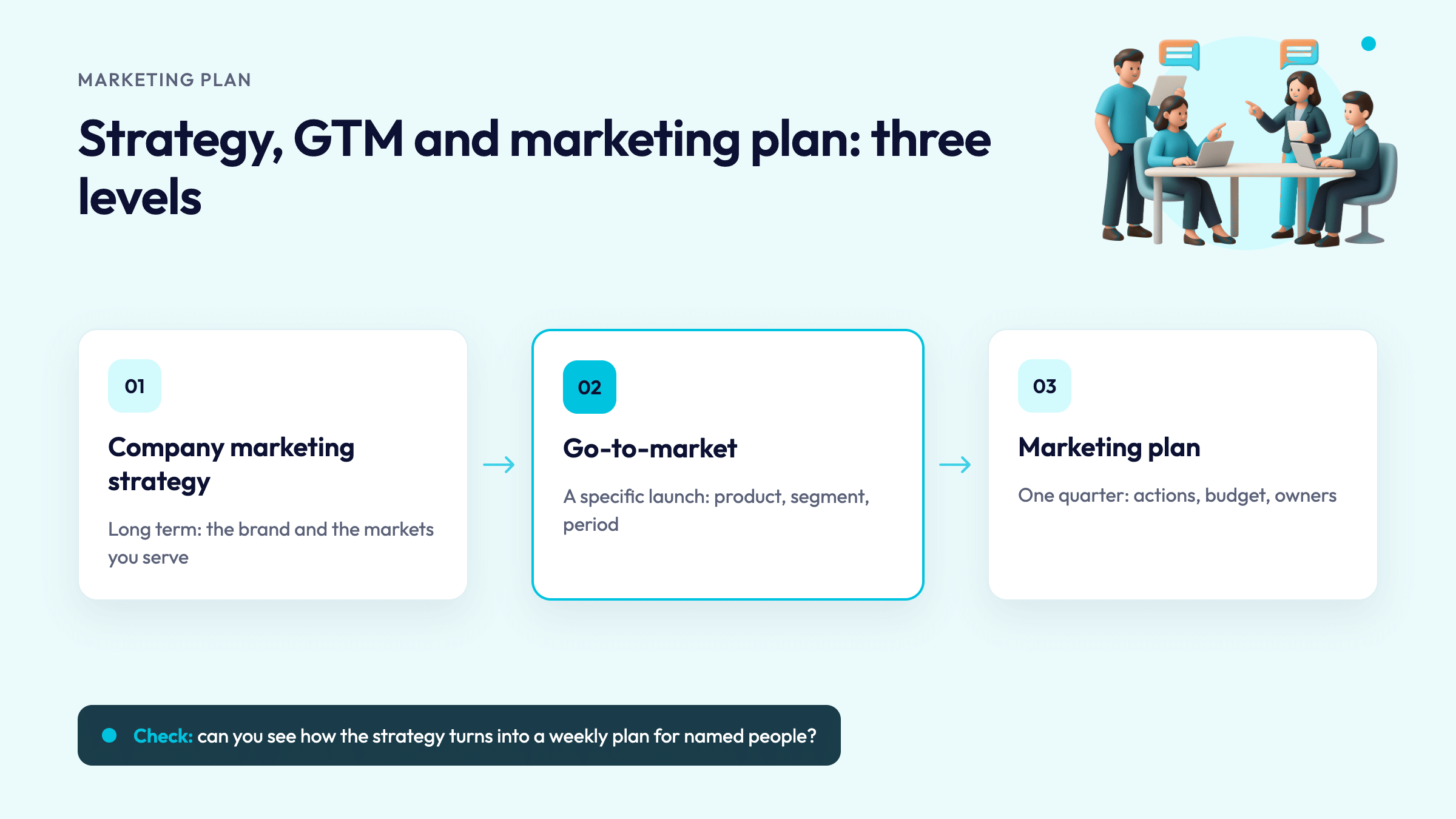
A company’s marketing strategy, its marketing plan and GTM are three different levels that are easy to confuse:
- Company marketing strategy describes, in the long term, how the brand wants to be perceived and which markets it operates in.
- GTM covers a specific launch: product, segment, period.
- The marketing plan is the schedule of activities, budget and owners that deliver GTM in a given quarter.
A marketing plan in a GTM model has a few features that set it apart from a classic plan:
- It is built together with sales: marketing and sales share one goal measured in opportunities and deals.
- It is shorter and updated more often, because at launch most assumptions will turn out wrong.
- Every element has a hypothesis it is meant to test.
A marketing plan where you cannot say what you will change after the first month is too rigid for a launch.
What does this look like in practice? Marketing and sales strategy start from the same ICP and the same value proposition. Marketing and product use the same insights from customer conversations. Strategy and marketing are measured on the result the board sees: revenue and the cost of acquiring it. The market strategy defines the segments, and the marketing plan sets out how much content, how many campaigns and events go into each one.
A good marketing strategy should also say what the company will not do. The market you are not entering this year is as important a decision as choosing the starting segment. The strategy and the team that delivers it have to fit: a five-channel plan for a two-person marketing team will end up with two channels delivered, and poorly.
Additional services, such as implementation or training, should be in the plan from the start, because they often tip the decision. The value you communicate should match what the salesperson says in the meeting.
When planning, one control question helps: what is our marketing strategy and how does it translate into a weekly plan for named people? If you cannot see that link, the marketing plan is a collection of ideas. A second check concerns sales: what does the marketing strategy mean for salespeople, in terms of what materials they will get, what leads and when.
A marketing strategy for a company that is just entering the market should fit on one page, and the quarterly marketing plan in one spreadsheet. At this level a go-to-market strategy and a GTM strategy are the same document, read by different people.
The sales team in GTM: who will close the first deals
The most expensive mistake in GTM is hiring a sales team before the company knows what it is selling and to whom. Three salespeople who get a product, a price list and a list of industries spend six months trying to discover what the board did not. Some leave, the rest sell to customers outside the ICP, and the company learns through costly mistakes.
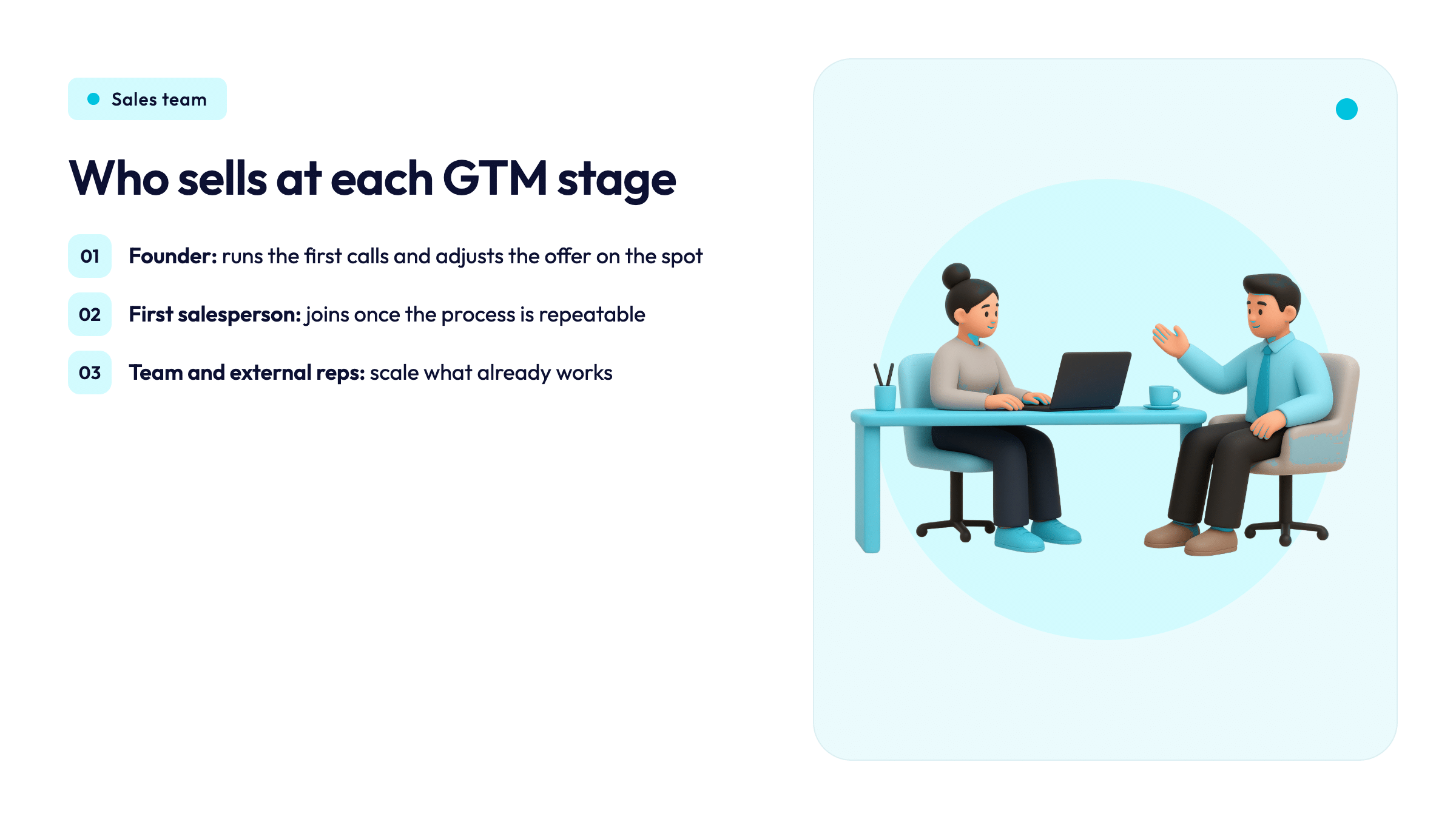
In the first stage, it is usually the founder or someone from the leadership team who sells. The reason is simple: they can make decisions during the conversation and change the offer, the price or the scope on the spot.
The first salesperson joins once there is a repeatable process: you know who to call, what to say and which objections come up. Strategy and the sales team have to be in sync: the profile of the first hires depends on the channel and the price. How easy someone is to find matters much less.
A GTM strategy for the team should define what you expect from the first hires. The first salesperson in a startup is someone who enjoys uncertainty, builds their own list, tests the message and comes back with insights. A salesperson from a large company, used to ready-made leads and materials, often struggles in that environment.
If you are considering someone with less experience, read how to hire a salesperson without experience and train them.
We write about building such a team quickly and without burning the budget in the article how to build an effective sales team fast, and about recruiting the first people in the guide how to assess a sales candidate’s skills.
Marketing and the sales team need shared tools. Sales collateral, meaning the materials that support sales (a deck, case studies, objection handling, an ROI calculator), comes out of the conversations salespeople have.
Marketing and the team that uses its materials work well when salespeople influence the materials and marketing hears objections first-hand. In this model marketing and sales are one process, where leads are not tossed from one department to another.
The second decision is the team model:
- An in-house team gives you control and builds knowledge inside the company, but takes time to recruit and onboard.
- External salespeople or freelance reps let you test the market faster, before the company invests in full-time hires.
Your strategy should say which model makes sense at which stage, and how knowledge is passed between external and internal people.
Strategy and the sales team also have to cover compensation: a commission model for a product with a long cycle needs a different structure than one for fast sales, as we explain in the article on commission models for salespeople. Without the right team, a go-to-market strategy remains a plan, and there is nobody to test the GTM strategy in practice.
Product launch step by step: a 90-day launch
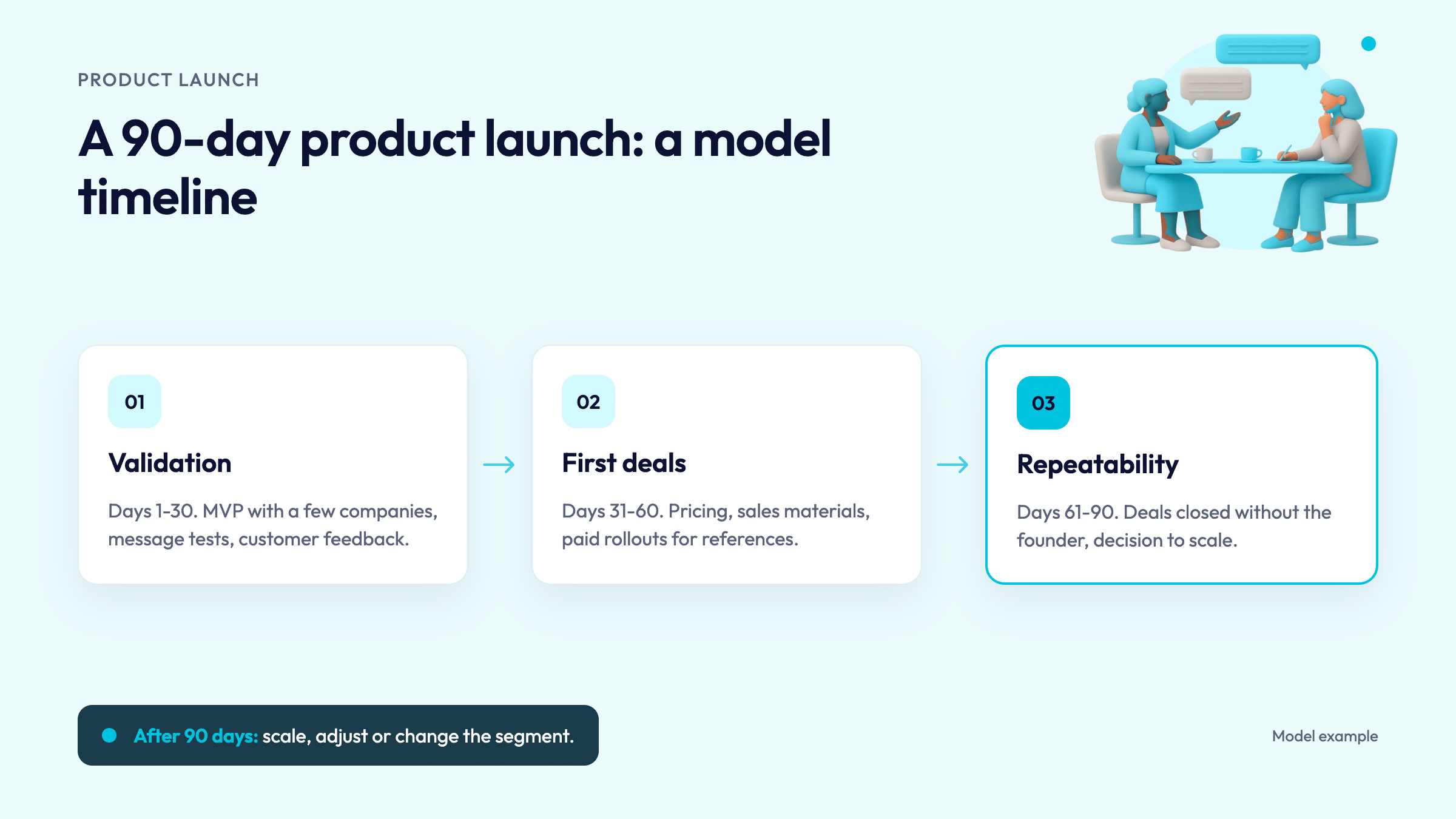
Below is a model timeline. It is an example that shows the order of decisions; every company will adapt it to its own situation. How long each stage takes depends on the sales cycle and how ready the product is.
Days 1-30: validation. The product, in its minimum viable product (MVP) version, goes to a few companies from the starting segment. The goal is customer feedback: does the product solve the problem, how do users use it, what blocks them. At the same time the founder or the first salesperson talks to the target account list and tests two or three versions of the message. The product strategy is still fluid, and that is fine.
Days 31-60: first deals. Based on the conversations, the first version of pricing, materials and process takes shape. The goal is the first paid rollouts, even on preferential terms in exchange for references and a case study. The marketing plan starts running in a lean version: a website, a few pieces of content answering the most common questions, a campaign to the account list. Product and strategy get hard data on what companies actually pay for.
Days 61-90: repeatability. You check whether further deals can be closed without the founder, following the documented process. If yes, it is a signal to grow the sales team and increase the budget for the main channel. If not, you go back to the choice of market and segment. After 90 days the product launch should end with a decision: scale, adjust or change the segment.
This timeline shows that launching a product is a sequence of tests, not a single event. A new product rarely hits the market with the first version of its message. A product launch planned as one big campaign with a single date leaves little room for corrections. A go-to-market strategy planned as a 90-day cycle with checkpoints gives you time to change direction before the budget runs out.
When planning the budget for this period, the article on startup budget and runway will help.
Oatly’s market entry strategy: what B2B companies can learn from an oat drink brand
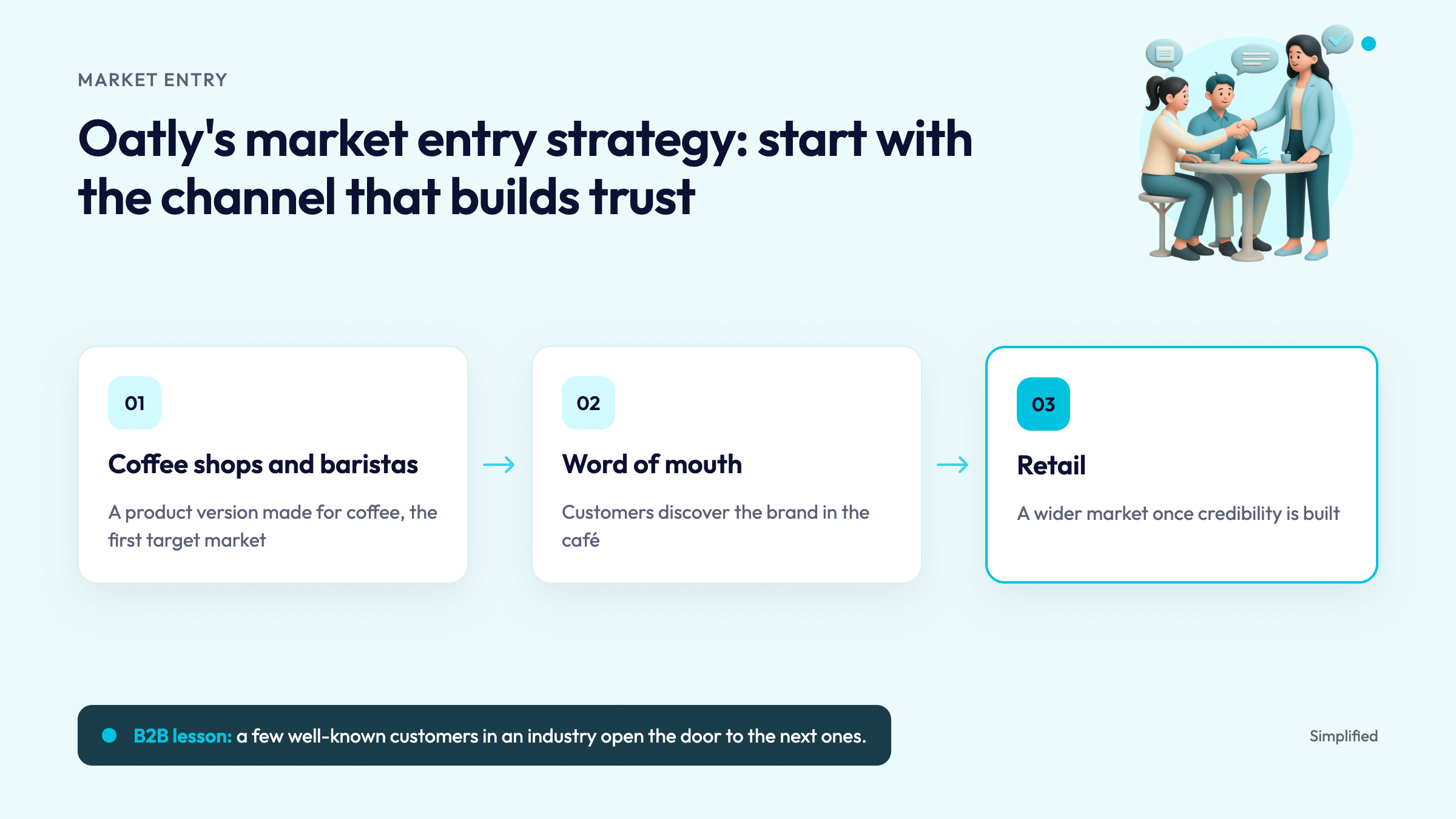
Market strategy examples from B2C rarely translate directly to B2B, but this one is an exception, because it is about choosing the starting channel and segment. Oatly’s market entry strategy in the United States is often described as an example of entering through the channel that builds credibility rather than the one with the biggest reach.
When the Swedish oat drink maker entered the US market, it did not start with the shelves of large supermarket chains. It started with specialty coffee shops and baristas, with a version of the product made for their needs, one that works well in coffee. Baristas became its first target market and its ambassadors at the same time: customers discovered the brand in the café before finding it in a shop. Retail came only later, as the wider market.
What does this mean for B2B?
- The starting segment does not have to be the biggest. It has to be the one that makes the product credible to the next segments. In B2B that is often a few well-known companies in an industry whose logos open doors to the next ones.
- A product tailored to the first segment sells better than a product for everyone.
- A channel can build trust before it builds revenue: a new brand can deliberately start with a channel that brings less revenue but more trust.
It is one of the most interesting market strategy examples precisely because it shows discipline: a go-to-market strategy built on one well-chosen point of entry.
How to measure whether go-to-market works: MQL, CAC and sales cycle length
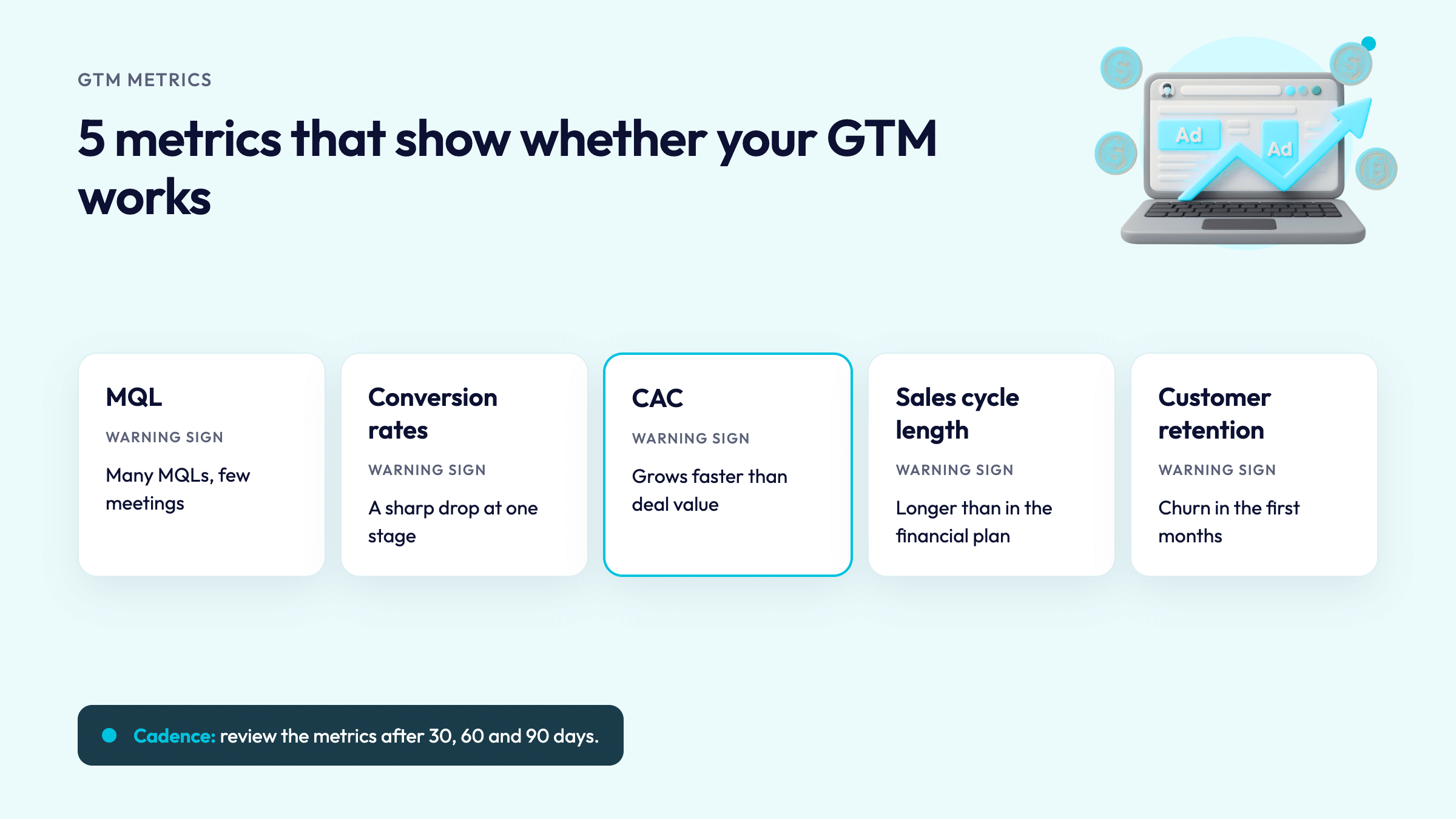
After launch the team usually looks at what is easy to measure: website traffic, number of leads, number of demos. These are activity metrics. A GTM strategy is judged by metrics that show whether the business model works.
| Metric | What it shows | Warning sign |
|---|---|---|
| Marketing-qualified lead (MQL) | how many contacts meet the criteria for a conversation | many MQLs, few meetings booked |
| Conversion rates between stages | where opportunities drop off | a sharp drop at one stage |
| Customer acquisition cost (CAC) | what it costs to win one customer | CAC grows faster than deal value |
| Sales cycle length | how long it takes from first conversation to signature | the cycle is longer than in the financial plan |
| Customer retention | whether companies stay after the first period | churn in the first months |
Each of these metrics only makes sense compared with the assumptions in the plan. If your GTM assumed a two-month cycle and after the first deals it is five months, the whole calculation changes: the budget you need, the number of opportunities in the pipeline, when to hire the next people. A sales team that sees these numbers every week spots problems faster than a board reviewing a quarterly report.
Retention matters most. A product launch can look like a success because contracts are being signed, and six months later it turns out customers are not renewing. That is a sign the sales promise is bigger than what the product delivers, or that sales is closing customers outside the ICP. Your go-to-market strategy should include a review of these metrics after 30, 60 and 90 days, with a decision on what to change.
All this data has to go into one CRM that the team actually uses. If you are choosing a tool for the start, see our CRM ranking.
The most common GTM mistakes that stop customers from buying
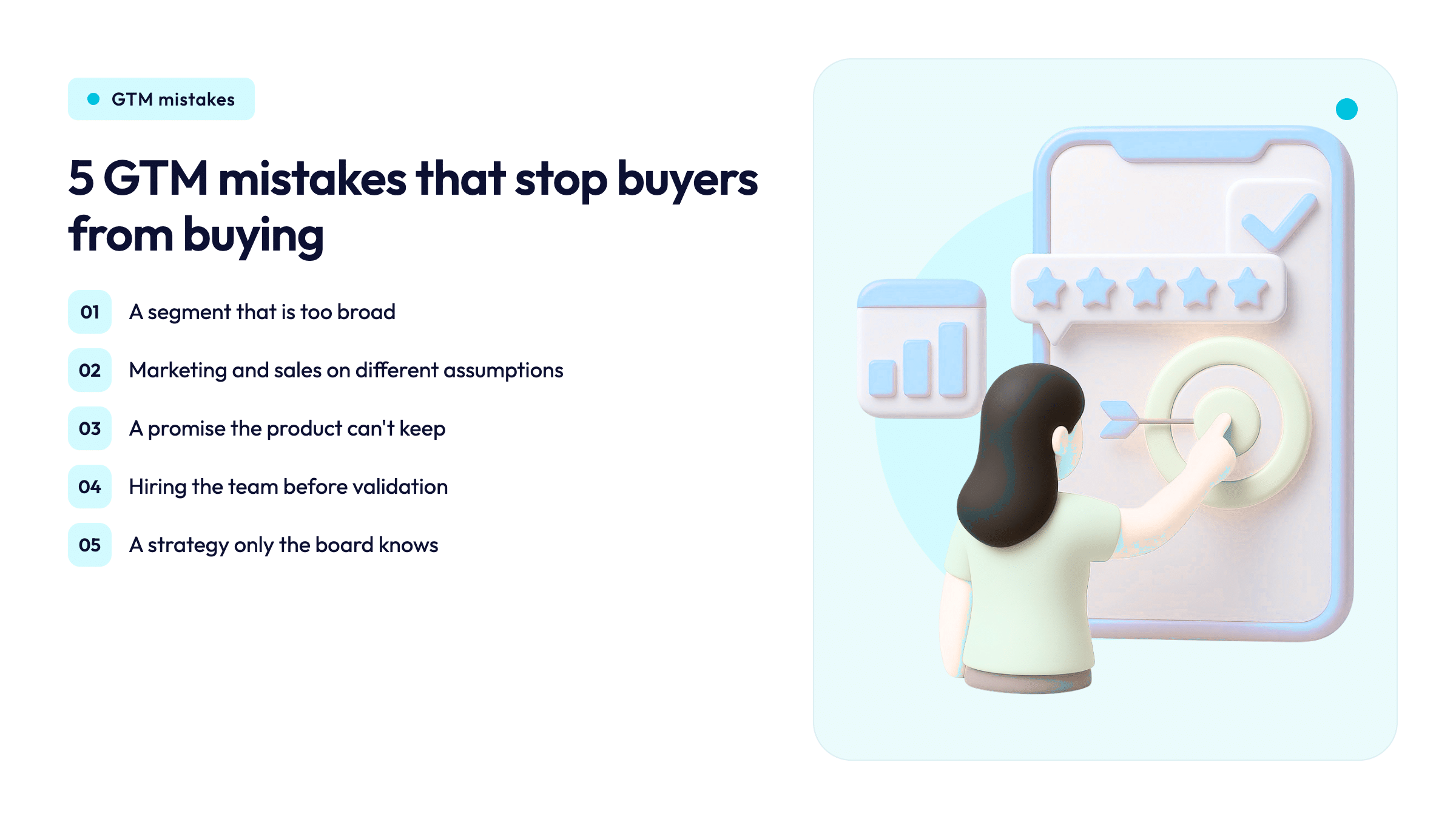
1. A segment that is too broad. Market segmentation at the level of “service companies in Poland” makes the message generic, and every customer needs a different conversation. Marketing and sales materials should describe the target market in the same words. An early-stage GTM strategy should have the courage to choose one segment and focus on it, even if it means giving up some leads.
2. Marketing and sales on different assumptions. Sales and marketing strategies built separately produce leads that sales cannot close and salespeople who do not use marketing materials. Marketing and sales need one goal, shared definitions and shared meetings. Without that, a go-to-market strategy is just a compromise between two plans.
3. A promise the product cannot keep. Customers who bought because of a promise quickly drift away when the product does not deliver the result in the promised time. The cost is not only a lost customer, but also the references the company needs in the next segment.
4. Hiring the team before validation. A sales team hired too early sells to an ICP that exists only in a deck. The customers you actually talk to should decide when you hire. A budget plan from the start of the year is a poor guide here.
5. A strategy only the board knows. In many companies the marketing strategy and how to execute it are known to a few people in leadership. A salesperson who does not know the goal, the priority segment and the reason a customer should buy right now will sell their own way. A GTM strategy works when everyone who talks to customers understands it.
In practice, a go-to-market strategy is a series of decisions worth making before launch and then regularly checking against data from conversations and the pipeline. Start with the segment and the value proposition, choose one main channel and plan the first 90 days with checkpoints. If you need people who will run those first conversations and close the first deals, dealme helps companies build a sales team that fits the market entry stage.