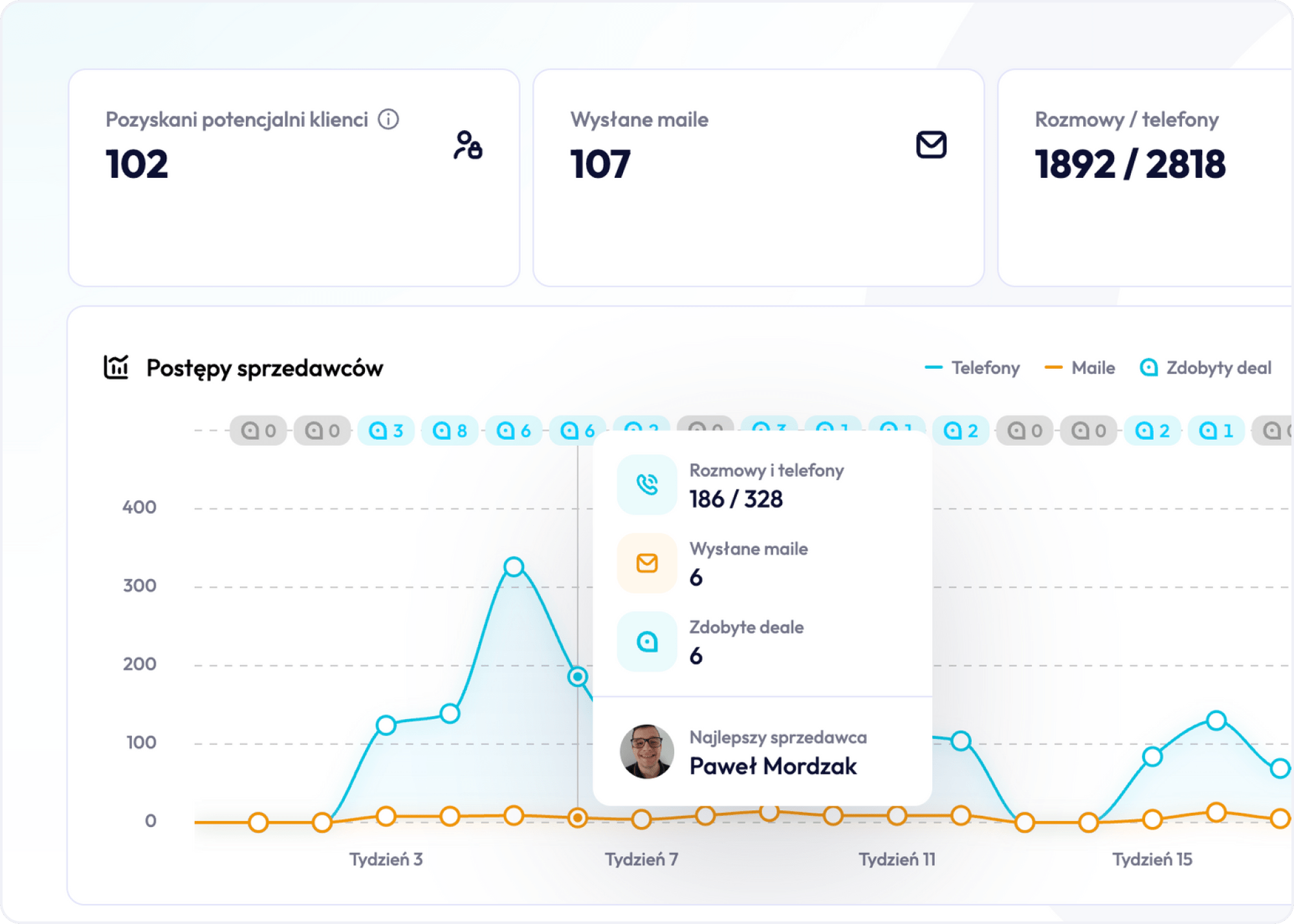
Why Cold Calling Still Works in Modern B2B Sales
Just a few years ago, many sales leaders predicted that cold calling would disappear, replaced by LinkedIn outreach, email automation, and digital marketing.
The opposite has happened.
As more companies invest in outbound sales and lead generation, it’s becoming increasingly difficult to stand out with yet another LinkedIn message or another email landing in an already crowded inbox.
That’s exactly why phone conversations are making a comeback.
Not as traditional telemarketing, but as a strategic part of a modern outbound process built around data, personalization, preparation, and consistent execution.
Today’s highest-performing sales teams don’t treat cold calling as a standalone activity. Instead, it’s integrated into a broader workflow that includes prospecting, lead list building, cold email outreach, follow-ups, and CRM management.
When these elements work together, businesses can build a predictable pipeline and consistently generate qualified sales opportunities.
Why Cold Calling Still Works in B2B
Many sales leaders assume cold calling has become ineffective because decision-makers are overwhelmed by sales outreach.
In reality, the problem usually isn’t the phone itself.
It’s how companies use it.
Cold calling remains highly effective because it creates an immediate connection with decision-makers. Unlike contact forms or paid advertising, a phone conversation allows sales reps to qualify prospects in real time, understand their business challenges, and quickly determine whether there’s potential for a meaningful opportunity.
In modern B2B sales, the objective of a cold call is rarely to close a deal during the first conversation.
Instead, the goal is to spark interest, qualify the prospect, and secure the next step in the sales process.
Companies that understand this consistently outperform businesses that try to sell their product within the first few minutes of the call.
Cold calling is particularly effective when selling high-value services, technology solutions, outsourcing, or any B2B offering that requires conversations with founders, executives, or senior decision-makers.
It also delivers something few marketing channels can provide: immediate market feedback.
After just a few dozen conversations, sales teams begin identifying recurring objections, common buying challenges, and messaging that consistently resonates with prospects.
For many organizations, cold calls have become a valuable source of insight—not only for sales teams but also for marketing and product development.
Modern Cold Calling Is Much More Than a Definition
Most definitions describe cold calling as contacting someone who has never interacted with your business before.
Technically, that’s correct.
Practically, it says very little about how modern B2B sales actually work.
The biggest mistake companies make is confusing cold calling with randomly calling people from purchased contact lists.
That approach resembles traditional telemarketing and typically results in poor conversion rates, frustrated sales teams, and wasted budgets.
Modern cold calling looks completely different.
Every conversation is supported by research, account qualification, and preparation before the first call is ever placed.
Sales representatives know who they’re calling, understand the prospect’s industry, recognize potential business challenges, and have a clear reason for reaching out.
As a result, the phone call itself becomes only one part of a much larger sales process.
Prospecting, account research, personalization, CRM management, and follow-up all contribute just as much to success as the conversation itself.
Leading sales organizations don’t measure cold calling performance by the number of calls made.
Instead, they focus on metrics that actually influence revenue:
- Conversations with decision-makers
- Meetings booked
- Qualified sales opportunities
- Pipeline generated
That’s why modern B2B cold calling is increasingly handled by specialized outbound or prospecting teams.
Their role isn’t to close deals over the phone.
Their job is to create qualified sales opportunities that move efficiently into the rest of the sales pipeline.
Prospecting: The Foundation of Successful Cold Calling
Many companies try to improve cold calling performance by rewriting their scripts or investing in sales training. More often than not, the real problem starts much earlier—during prospecting. If your lead list is poorly built, even the most experienced sales rep will struggle to deliver consistent results. Conversations happen with the wrong people, response rates drop, and the entire outbound process becomes inefficient.
Effective prospecting begins with defining your Ideal Customer Profile (ICP). In B2B sales, company size and industry are only part of the picture. Organizational structure, growth stage, technology stack, and buying signals all play an important role in identifying companies that are genuinely likely to become customers.
Building a high-quality prospect list starts with answering a few critical questions:
- Who makes the buying decision?
- Which business problems does our solution solve?
- What buying signals indicate a company may need our product?
- When are organizations most likely to begin evaluating new solutions?
A strong prospect database isn’t simply a spreadsheet of company names. It’s a carefully curated list of businesses that match your commercial objectives. The higher the quality of your prospect list, the more effective every stage of your outbound sales process becomes.
That’s why modern sales teams increasingly rely on tools such as LinkedIn Sales Navigator, CRM platforms, data intelligence solutions, and prospecting tools like Bazo. These platforms help teams identify, segment, and prioritize high-value accounts instead of relying on generic contact lists. In many outbound campaigns, success depends far more on the quality of the prospect list than on the person making the call. Organizations that invest in better prospecting consistently achieve higher conversion rates without increasing call volume.
Building Better Contact Lists with Bazo and Sales Intelligence
Many companies begin a cold calling campaign by writing a call script. The best sales teams begin somewhere else—they start by identifying companies that actually fit their Ideal Customer Profile.
Instead of purchasing large databases of random contacts, they build targeted prospect lists using multiple sources of business intelligence. LinkedIn, CRM systems, prospecting platforms, and solutions like Bazo make it possible to filter companies based on criteria such as industry, company size, employee count, location, or technology stack.
Research doesn’t stop with the company itself. Sales representatives also need to understand why a particular organization belongs on the target list and who the right decision-maker is before picking up the phone. A conversation with a founder naturally differs from one with a VP of Sales, a COO, or another executive responsible for a specific business function.
That’s why segmentation is one of the strongest predictors of cold calling success. The more precisely prospects are segmented, the easier it becomes to deliver relevant conversations that generate genuine interest.
High-performing sales organizations treat their contact database as a strategic business asset. They continuously update records, remove outdated contacts, enrich account information, and improve data quality. Every new outbound campaign starts with better data—and delivers better results.
Personalization and Value-Driven Conversations
One of the fastest ways to lose a prospect is to begin the call by talking about your company. Decision-makers hear similar introductions every day, making it easy to tune out within the first few seconds.
Successful cold calling takes a different approach. Instead of introducing the company first, top-performing sales reps demonstrate that they understand the prospect’s business. True personalization isn’t mentioning the company name or repeating information found on a website. It’s showing that you understand the prospect’s market, challenges, and business priorities.
For example, a conversation with a manufacturing company might begin by discussing customer acquisition or international expansion, while a software company may be more interested in pipeline generation or improving outbound performance. That immediately gives the conversation context and makes it feel relevant rather than sounding like another generic sales pitch.
The same principle applies to messaging. Customers rarely buy software because it includes a particular feature. They invest because it helps increase revenue, reduce costs, improve efficiency, or solve an important business problem.
Cold calling also provides one of the fastest ways to validate your messaging. After just a few dozen conversations, patterns begin to emerge. Some talking points consistently generate interest, while others quickly end the conversation. That’s why effective cold calling isn’t built around memorizing scripts—it’s built around continuously testing messaging, learning from customer feedback, and refining conversations over time.
Cold Calling Scripts and Techniques That Improve Results
One of the biggest misconceptions in sales is that experienced sales reps don’t need a script. In reality, the best outbound teams rely on call frameworks every day—not because they read them word for word, but because they provide structure, consistency, and direction.
A well-designed cold calling script isn’t meant to sound robotic. Instead, it helps sales reps guide the conversation, ask the right qualifying questions, handle common objections, and move prospects naturally to the next stage of the sales process. The biggest mistake is treating a script as something to memorize. Prospects recognize scripted conversations almost immediately, and once they realize they’re listening to a rehearsed pitch, engagement quickly disappears.
The most effective cold calling techniques focus on asking thoughtful questions rather than delivering long presentations. Instead of spending the first few minutes talking about your company, experienced sales reps shift the conversation toward the prospect’s business, current challenges, and priorities. The more relevant information they gather, the easier it becomes to tailor the discussion around what actually matters to the buyer.
Managing the pace of the conversation is equally important. Trying to sell too early often creates resistance, while spending too much time without a clear objective causes the conversation to lose momentum. Every call should begin with a defined goal, include qualification questions, prepare for likely objections, establish a clear next step, and end with an appropriate follow-up plan.
The best cold calls don’t sound like sales presentations. They feel like business conversations focused on understanding whether there’s a genuine opportunity to work together.

Handling Objections During Cold Calls
Most cold calls don’t fail during the opening. The real challenge begins when prospects raise objections. Every outbound sales rep regularly hears responses like “We don’t have time,” “We’re already working with another provider,” “Just send me an email,” or “This isn’t a priority right now.”
The biggest mistake is treating these responses as final rejections. In most cases, they’re simply a natural reaction from someone who doesn’t yet understand the value being offered. That’s why objection handling is such an important part of successful cold calling.
The objective isn’t to argue with prospects or convince them they’re wrong. Instead, skilled sales professionals ask questions that uncover the context behind the objection. If a prospect says they’re already working with another vendor, a better response might be, “Are you completely satisfied with the results you’re getting, or are there areas you’d still like to improve?”
Questions like these shift the conversation away from defending your solution and toward understanding the prospect’s business. Sales psychology consistently shows that people are far more willing to discuss their own challenges than listen to a product presentation. For that reason, cold calls should focus on discovering needs rather than pitching features.
Prepared objection-handling frameworks provide valuable guidance, but every conversation is different. Industries, companies, and decision-makers all operate in unique contexts, so sales reps need to adapt naturally instead of relying on memorized responses. High-performing sales organizations regularly review recorded calls, analyze recurring objections, and update their training materials so every conversation becomes an opportunity to improve future performance.
Cold Email, Warm Calling, and Modern Outbound Automation
One of the biggest reasons outbound campaigns underperform is that companies treat each sales channel as a separate initiative. The strongest outbound teams take the opposite approach, building coordinated, multi-touch sequences where every interaction supports the next.
A prospect might first receive a personalized cold email, then come across your company on LinkedIn, and only afterward receive a phone call. At that point, the conversation no longer feels completely cold because some level of familiarity already exists.
This is where warm calling becomes especially effective. Instead of introducing the company from scratch, sales reps can reference a previous email, downloaded content, website activity, or another earlier interaction. The conversation begins with context rather than interruption, making prospects far more willing to engage.
Automation makes this entire process significantly easier to manage. CRM platforms, cold email software, and prospecting tools help sales teams schedule outreach, monitor engagement, automate follow-ups, and prioritize the accounts most likely to convert. The purpose of automation isn’t to replace sales professionals but to eliminate repetitive administrative work so they can spend more time having valuable conversations.
The most successful outbound organizations don’t see cold email, cold calling, LinkedIn outreach, CRM workflows, and follow-ups as separate activities. They operate as one connected sales system where every touchpoint builds on the previous one, making pipeline generation far more predictable than relying on isolated outreach efforts.
What the 2025 Cognism Report Says About Cold Calling Performance
Despite the rapid growth of automation, AI, and inbound marketing, the 2025 Cognism State of Cold Calling Report shows that phone calls remain one of the most effective channels for generating qualified sales opportunities in B2B.
The reason is straightforward. Decision-makers receive dozens of emails and LinkedIn messages every day, making it increasingly difficult to capture their attention through written communication alone. A phone call still offers something other channels can’t—an immediate conversation and real-time feedback.
The same conclusion comes from outbound teams like DMSales. Their experience shows that the best-performing organizations don’t treat cold calling as an isolated activity. Instead, they integrate it into a broader outbound strategy that combines prospecting, personalization, CRM management, and structured follow-ups.
The report also highlights an important shift in how outbound success is measured. High-performing sales teams no longer focus on making as many calls as possible. They prioritize the quality of conversations, the relevance of each prospect, and the number of qualified sales opportunities generated.
This reflects a broader change in modern outbound sales. A few years ago, success was often measured by call volume alone. Today, the metrics that matter are conversation quality, personalization, conversion rates, and pipeline contribution.
How to Measure the Success of a Cold Calling Campaign
One of the biggest mistakes sales organizations make is measuring cold calling performance solely by the number of calls placed.
That metric provides very little insight into whether outbound activities are actually driving revenue.
A successful cold calling campaign should be evaluated across the entire sales funnel. Only by measuring every stage of the process can businesses identify where performance is strong and where improvements are needed.
Some of the most important KPIs include:
- Conversations with decision-makers
- Call answer rate
- Meetings booked
- Qualified sales opportunities
- Pipeline generated through outbound sales
- Closed revenue
Looking at these metrics together provides a much clearer picture than call volume alone.
For example, a sales team may consistently book meetings, but if very few opportunities progress through the pipeline, the issue probably isn’t cold calling. More likely, the problem lies in lead qualification or prospect targeting.
Conversion rates between each stage of the sales process are equally valuable.
If prospects answer the phone but rarely agree to a meeting, the opening message may need improvement. If meetings are booked but rarely progress further, it may be time to review the quality of prospecting or the product’s fit for the target audience.
Companies that use CRM systems have a significant advantage because they can track the entire customer journey—from the first phone call to a closed deal. This visibility makes it much easier to identify which outbound activities generate measurable business results.
Helping Sales Teams Overcome Cold Calling Anxiety
Fear of cold calling is one of the most common challenges facing both new and experienced sales professionals.
Many hesitate because they’re afraid of rejection, difficult conversations, or not knowing how to respond to unexpected questions.
Unfortunately, avoiding phone calls only makes the problem worse.
Sales reps who make fewer calls gain less experience, develop less confidence, and become increasingly hesitant over time.
That’s why effective sales training goes far beyond product knowledge.
High-performing organizations regularly practice sales conversations, review recorded calls, role-play difficult scenarios, and encourage open discussions about challenging situations.
The most successful sales cultures treat mistakes as learning opportunities rather than failures.
This creates an environment where sales reps feel comfortable experimenting with new approaches, improving their communication skills, and developing confidence through repetition.
It’s also important to remember that rejection is a normal part of sales.
Even the best sales professionals hear “no” every day.
Success doesn’t come from avoiding rejection—it comes from consistently executing the process, learning from every conversation, and improving over time.
Well-trained sales teams understand that no single phone call determines the outcome of an entire campaign. Long-term success depends on consistency, continuous learning, and the ability to refine the process after every customer interaction.
Why Some Companies Scale Cold Calling Successfully While Others Don’t
The biggest difference between companies that consistently generate sales meetings and those that struggle with outbound isn’t talent.
It’s process.
High-performing organizations follow a clearly defined cold calling framework. They know how prospecting works, what qualifies a lead, when follow-ups should happen, and what actions move opportunities through the sales pipeline.
Cold calling is built on consistency.
Even exceptional sales professionals struggle without accurate data, a well-maintained CRM, clear qualification criteria, and strong marketing support.
The best outbound organizations treat prospecting as a permanent part of their growth strategy rather than an occasional campaign. They continuously improve their prospect databases, refine sales messaging, analyze conversations, and optimize performance using real customer data.
That’s why cold calling continues to deliver results in modern B2B sales.
Not because the phone itself is a magical sales channel, but because it remains one of the fastest ways to reach decision-makers, validate market demand, and create qualified sales opportunities.
To succeed in 2026 and beyond, however, cold calling must be part of a larger outbound system that includes prospecting, personalization, CRM, follow-ups, and a well-defined Go-to-Market strategy. When these elements work together, individual phone calls become a predictable engine for pipeline generation and sustainable revenue growth.

Frequently Asked Questions About Cold Calling
Does Cold Calling Still Work in 2026?
Yes—but only when it’s part of a broader outbound sales strategy. Cold calling alone is becoming less effective, especially when it’s done without prospecting, personalization, or structured follow-ups. The highest-performing sales teams combine phone outreach with cold email, LinkedIn engagement, CRM workflows, and account research to create a coordinated outbound process.
How Many Calls Does It Take to Book a Meeting?
There’s no universal benchmark.
Results depend on several factors, including the quality of your prospect list, your target market, the level of personalization, and the experience of your sales team. Well-prepared outbound campaigns consistently outperform high-volume calling strategies built around random contact lists.
What’s the Difference Between Cold Calling and Telemarketing?
Although they’re often confused, they’re not the same.
Traditional telemarketing typically focuses on high-volume outreach with the goal of making a sale during the first conversation. Modern B2B cold calling has a different objective. It’s designed to qualify prospects, understand business challenges, and secure the next step in the sales process rather than closing a deal immediately.
Should You Combine Cold Calling with Cold Email?
Absolutely.
Cold email helps introduce your company before the phone call, making prospects more familiar with your brand. As a result, the conversation feels warmer and sales reps have a much better chance of starting a meaningful discussion.
The most effective outbound strategies combine email, LinkedIn, phone calls, and follow-ups into one coordinated workflow instead of relying on a single communication channel.
What Are the Most Common Cold Calling Mistakes?
Some of the biggest mistakes include:
- Working from low-quality prospect lists
- Failing to personalize conversations
- Reading scripts word for word
- Starting calls without proper research
- Neglecting follow-ups
- Failing to analyze sales performance in the CRM
Conclusion
Cold calling hasn’t disappeared with the rise of LinkedIn, AI, and sales automation. In fact, for many B2B organizations, it remains one of the fastest and most effective ways to reach decision-makers and generate qualified sales opportunities.
What has changed is the way successful companies approach it.
Modern cold calling is no longer about maximizing call volume. Success depends on high-quality prospecting, accurate contact data, personalized conversations, structured follow-ups, and a repeatable outbound process supported by CRM and sales technology.
Organizations that treat cold calling as one component of a broader outbound strategy consistently build stronger pipelines and generate more predictable revenue than those relying on isolated outreach efforts.
When combined with prospecting, automation, CRM, and data-driven optimization, cold calling remains one of the most valuable tools in modern B2B sales.