GTM engineer: who they are and what they do in a company that wants to scale sales
A company has a CRM, a sequencing tool, a contact database, a form on the website and a spreadsheet where SDRs keep “their” lists. Every tool works on its own. An inbound lead waits two days to be assigned, and the pipeline in the CRM looks healthy until someone checks how many deals nobody has touched in a month.
This is where a GTM engineer comes in. A GTM engineer connects the CRM, the sales tools and the data sources into a single flow: from the first signal that a company might buy to a meeting in a rep’s calendar. In teams that have made this shift, the GTM engineer becomes the person without whom a new rep takes far longer to get up to speed.
Below you’ll find what a GTM engineer actually does day to day, how the role differs from RevOps, which tools it relies on and when the role pays off. If you’re thinking about becoming one, the last section is for you.
Who is a GTM engineer and why did companies start hiring them?
The team grows from three reps to eight, but revenue doesn’t grow with it. Every new SDR spends weeks building their own lists, and pipeline depends on who put in the most hours of research. That’s usually the moment a company starts looking for a GTM engineer.
A GTM engineer is a technical operator who builds automation around the sales process. They connect data, tools and rules so that a rep gets the context they need up front: who to contact, when, and why now. The role starts exactly where manual spreadsheet work ends.
Three shifts made the role possible:
- Sales tools are programmable. CRMs, sequencing platforms and data providers have APIs and native integrations, so you can wire them together without a team of developers.
- Company data is available on demand. Enrichment, hiring signals and technology changes can be pulled automatically.
- Customer acquisition keeps getting more expensive. Adding headcount is no longer the only lever for more pipeline.
GTM engineers know both worlds: technology and the sales process. Many of them did similar work in sales operations or growth before the role had a name. Because they understand how reps actually work, their automation removes friction instead of adding it. A good GTM engineer thinks like a seller and builds like an engineer.
Companies need a GTM engineer once growth stops depending on how many people are on the phones and starts depending on how well their systems work. Smaller companies often bring one in for a project rather than a full-time role.
GTM roles: where the SDR’s and marketer’s job ends and the engineer’s begins
Here’s how GTM roles typically split in practice:
- SDR and BDR: first contact and qualification, measured by meetings booked and their quality.
- Marketer: demand, campaigns, inbound leads.
- Sales ops: stage definitions, reporting, CRM hygiene.
- GTM engineer: the automation that ties these together. It pulls data, enriches it, scores it and routes it to the right person.
What sets a GTM engineer apart is that their output is a working system. Sales ops keeps the house in order, the GTM engineer adds new machinery. Compared with a developer, the scope is different: they build infrastructure around sales and leave the product to the engineering team. Compared with a marketer, success is measured in meetings and clean CRM data rather than reach.
The role looks very different in a startup and in an enterprise. In a startup, the GTM engineer is CRM admin, analyst and integrations person all at once. In a company with several sales teams, they might own nothing but lead routing. That’s why it pays to define the scope before you hire, ideally right in the job title, for example: “GTM Engineer: sales team, owning routing and enrichment”.
What is GTM engineering and what does a GTM system that doesn’t lose leads look like?
Someone visits your pricing page, leaves their email in a form, and nothing happens for two days. In the meantime, they’ve talked to a competitor.
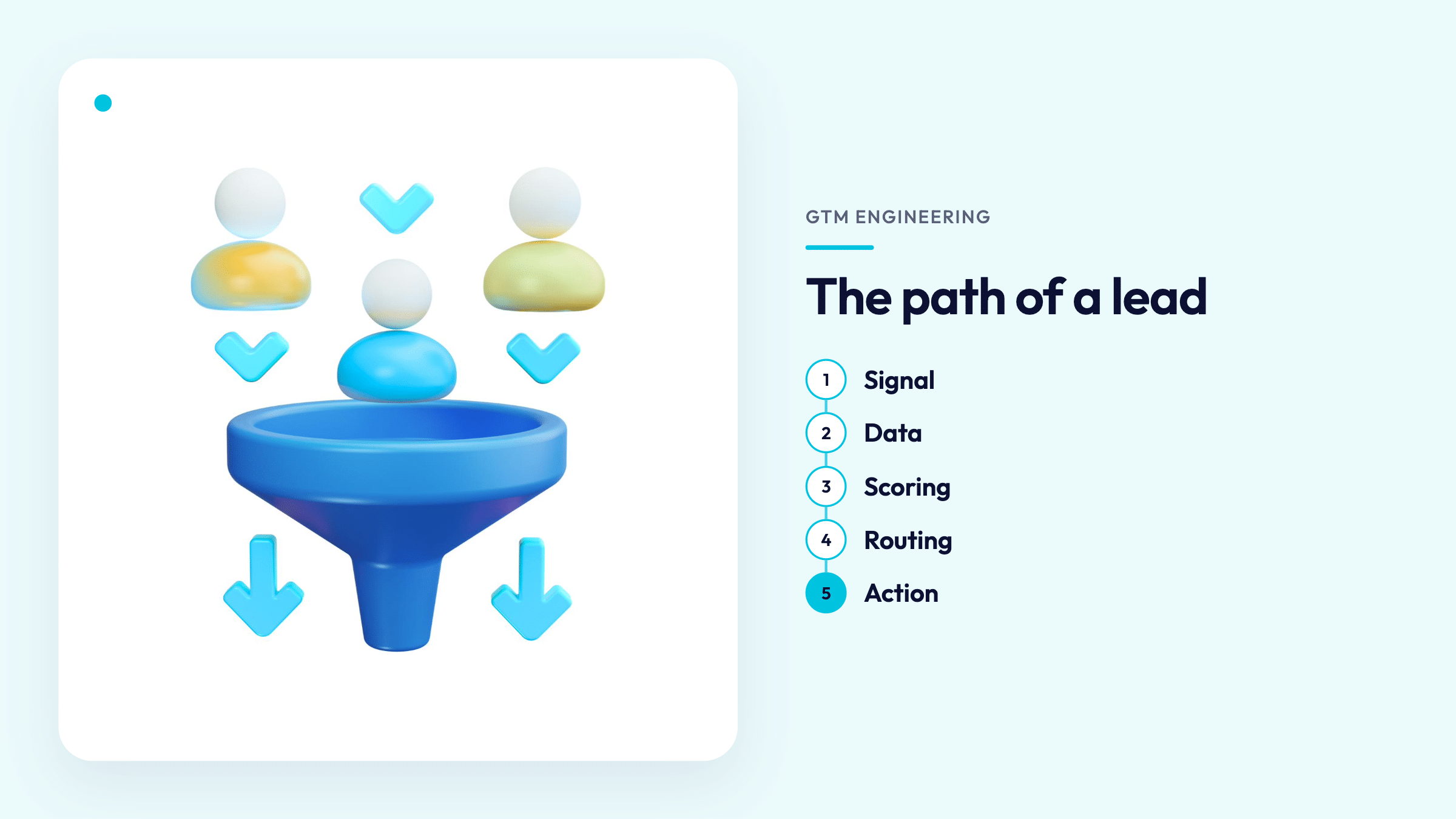
GTM engineering is the design of the path every potential customer takes, from the first signal to a closed deal. Each step has a rule, a data source and an owner. This is what the whole go-to-market motion looks like when someone has actually designed it:
- Signal: a pricing page visit, a webinar sign-up, a relevant job posting, a tool change.
- Enrichment: industry, company size, decision-makers, tech stack.
- Scoring: ICP fit and urgency.
- Routing: the right rep or the right sequence.
- Action: an email, a call, a task in the CRM.
- Measurement: what came out of it and where the flow stalled.
A scalable GTM system works the same way at 50 leads a month and at 500 (illustrative example). It’s built from the ground up: first a solid data foundation, meaning clean account and contact data, then automation, and reporting last. GTM engineering without that foundation just automates the mess.
What happens without this flow? Every rep has their own way of working, and marketing and sales measure conversion differently. What’s missing is real sales and marketing alignment: shared definitions and one view of the funnel.
Your GTM motion (outbound, inbound, product-led, partners) determines what a GTM engineer needs to build. The same go-to-market strategy can require completely different automation in two companies, and changing your motion changes the strategy at the operational level too.
GTM Engineering Function: who it reports to and what it owns
The most common mistake is never deciding who owns the role. Marketing sends integration requests, sales asks for lists, leadership wants reports, and three months later GTM engineering has turned into firefighting. A GTM engineer without a clear manager ends up working through a request queue instead of building.
The GTM engineering function works best with a single owner:
- within RevOps: the GTM engineer is part of the revenue operations team;
- under the Head of Sales or CRO: when the main goal is outbound pipeline;
- under the Head of Growth: common in SaaS companies with a large share of inbound.
Whichever model you choose, the GTM engineer owns the data flow. It’s closer to sales management than to marketing, because what it delivers is predictability. GTM engineers are usually also the first to notice when a process breaks, because their automations are the first thing to stop.
A quick test: can anyone in your company draw how your go-to-market works, from the form fill to the signed contract? If not, the whole thing lives in a few people’s heads.
GTM engineer vs RevOps: who builds the system and who watches the numbers?
| RevOps | GTM engineer | |
|---|---|---|
| Core question | Is the process consistent and measurable? | How do we automate it? |
| Output | stage definitions, reporting, forecast | workflows, integrations, enrichment, routing |
| Risk when the role is missing | disputed reports | manual work and tool chaos |
In smaller companies, the GTM engineer and the ops specialist are often the same person, and day-to-day CRM upkeep eats all their time. If you’re deciding which to hire first, it’s a choice between faster pipeline and better data for decisions.
Both roles share one goal: revenue that can be predicted. Ops shows where the flow gets stuck, and the GTM engineer works on unblocking it. Put simply, ops controls and the GTM engineer builds. GTM engineers are also a natural partner for sales and marketing alignment, because they’re the ones technically connecting data from both teams.
GTM engineering use cases: what a GTM engineer does in a typical week
The workflows below are the ones a GTM engineer typically builds in the first few months. The numbers are illustrative. GTM automation is never a one-off project: every change to your offer or ICP means new rules.
How do you feed the sales pipeline with buying signals instead of cold lists?
A list filtered by industry and job title doesn’t tell you who’s ready to talk right now. That’s why GTM engineers build signal-based workflows. An illustrative example:
- Signal: a company in your ICP is hiring three SDRs.
- Enrichment: company data plus the Head of Sales and their contact details.
- Scoring: points for fit and for how fresh the signal is.
- CRM: a record with a note on why to reach out.
- Sequence: a first email referencing the hiring, a call on day three.
The result is a sales pipeline where every deal has a reason to exist, and reps get opportunities with context instead of names from a database. Signal-based automation produces fewer contacts, but better ones. GTM engineers design the scoring together with the reps, keep adding new signals and drop the ones that don’t convert.
This is classic sales automation: you set it up once and extend it with new signals. In practice, several of these flows run in parallel, one per segment. Automation without quality control burns domains fast, so a GTM engineer sets sending limits and warms up domains before launch.
Where a company runs demand generation, the GTM engineer can connect webinar and content engagement with account data. The demand gen team then sees which campaigns actually led to meetings. Without that link, demand generation and outbound work off separate lists and get in each other’s way. Every step writes data back to the CRM, so after a month you can see which signals lead to conversations.
How do you free sales teams from manual research and copy-pasting data?
Before a call, a rep opens LinkedIn, the company website, the CRM and their inbox. After the call, they retype their notes. GTM engineers help sales teams win that time back:
- lead routing to the right person within minutes;
- a pre-meeting brief with contact history and open topics;
- post-call notes saved to the CRM together with the next task;
- data hygiene: merging duplicates and filling in missing fields.
This is usually where automation pays off fastest. The best GTM engineers build these systems together with the reps, because reps know which steps are pointless. In mature teams, the systems are designed around the existing sales process rather than forcing a new way of working.
How a GTM engineer calculates the impact (illustrative example):
- an SDR saves 5 hours a week on research and notes;
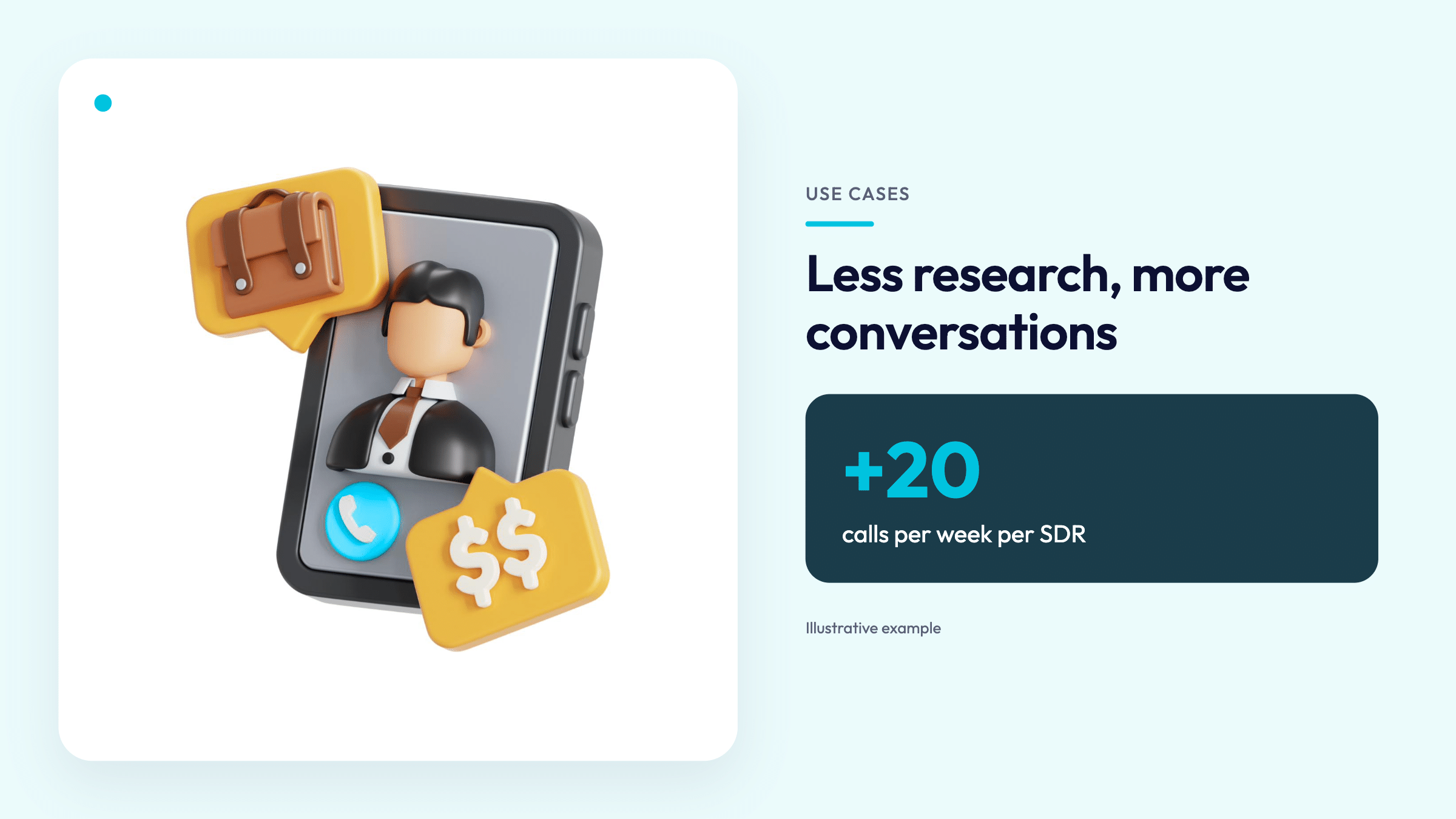
- an average call takes 15 minutes, which frees up room for roughly 20 more calls a week;
- with five SDRs, that’s around 100 more calls a week without a single new hire.
That’s what sales productivity looks like in numbers. Efficiency goes up because the same team handles more opportunities. And this argument tends to convince leadership faster than any slide deck, because it shows how GTM engineering translates into revenue.
GTM engineers also help with sales tactics by A/B testing sequence variants. When something stops working, they can change a rule in a day. Good automation is invisible to the prospect: the email should read like a person wrote it.
GTM Engineering Stack: what systems make up a GTM stack?
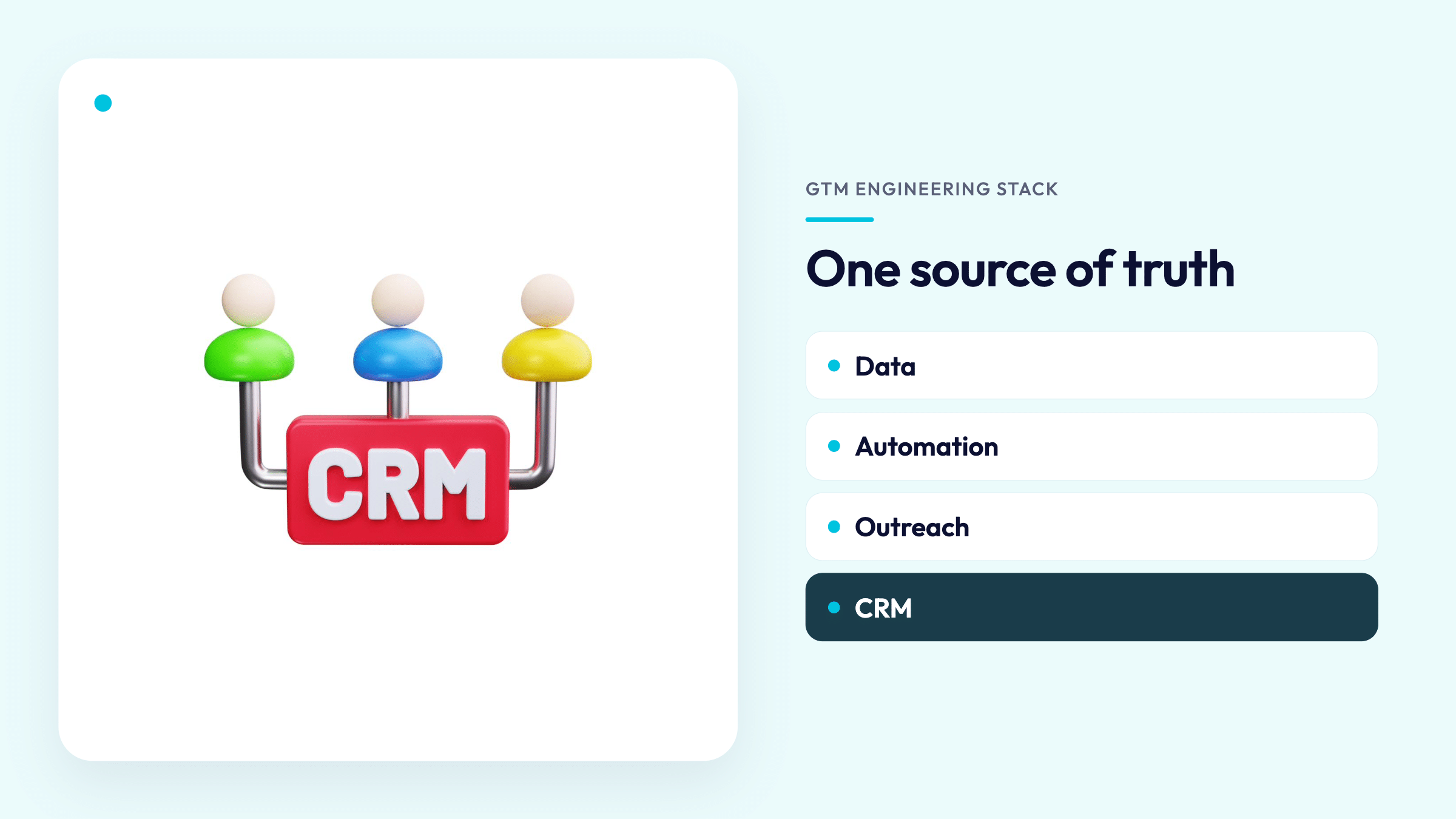
Marketing bought a form tool, sales bought a sequencing tool, someone added a contact database. Two years later, the company pays for a dozen licenses and a human moves data between them. That’s why a GTM engineer’s first job in a new company is an audit of the stack.
A GTM engineering stack is the same set of tools, organised into layers:
| Layer | What it’s for | Examples |
|---|---|---|
| CRM | the source of truth for accounts and deals | HubSpot, Raynet, Salesforce |
| Data | company and contact enrichment | Clay, Apollo, Cognism |
| Automation | connecting the tools | Make, Zapier, n8n |
| Outreach | email and call sequences | lemlist, CloudTalk |
| Analytics | reporting and forecasting | CRM reports, Looker Studio |
One rule holds the stack together: every piece of information has exactly one place where it’s up to date. Usually that’s the CRM. Without this rule, tools overwrite each other’s fields and nobody knows which value is correct.
A GTM engineer connects the layers so that data flows one way: from the tools into the CRM, and from the CRM into reporting and sequences. A stack built this way has one source of truth, documented flows and an owner for every integration. The systems reps live in sit at the top: if a rep has to leave the CRM to find information, the stack isn’t working.
GTM engineers build the data foundation first, with shared definitions of an account and a deal. Companies that build their stack around tools instead of data definitions usually end up rebuilding it within a year. A well-designed stack also lets you swap one tool without breaking the rest.
GTM engineers know their tools at the level of APIs and limits, not just the interface. They make sure every new tool passes a simple test: what problem does it solve, and where does it write its data? In a small company, a sensible stack is a CRM plus one tool each for data, automation and sequencing.
Where does Clay fit in a GTM stack, and when is it no longer enough?
Clay shows up in a lot of GTM engineer job postings. It pulls data from multiple sources into one table, enriches it and pushes it on. A GTM engineer uses Clay for:
- waterfall enrichment: if the first source doesn’t have the decision-maker’s email, Clay queries the next one;
- signal-based lists: hiring, technology changes, funding;
- personalisation of the first line of an email;
- scoring before a record is sent to the CRM.
Clay stops being enough when it turns into a second CRM. At that point, your stack has two sources of truth again. Clay should feed your CRM, not replace it. At scale, costs matter too, so a GTM engineer sets up expensive enrichment to run only for high-scoring accounts and connects Clay to the CRM through clear rules: what goes in, when, and with what status.
Sales enablement: data in the rep’s hands at the moment of the conversation
Plenty of companies have sales enablement on paper: a folder of decks and last year’s playbook. Before a meeting, the rep still goes looking for information on their own. A GTM engineer looks at this as a flow problem. In practice, they make sure the rep gets:
- account context in the CRM: industry, contact history, open deals;
- content matched to the deal stage: a case study from the same industry, attached to the deal;
- live signals: a notification when the prospect opens the proposal.
The GTM engineer also builds a feedback loop: a rep can flag outdated content in one click. Where the GTM engineer only provides the integration and nobody updates the content, the system goes stale fast. This is also one of the most practical paths to sales and marketing alignment: marketing can see which content actually helps close deals.
Sales enablement systems your team actually uses
A company buys a platform, uploads its materials, and three months later nobody opens it. Sales enablement systems only work when they’re built into the tools reps already use every day.
| Element | Owner | What the GTM engineer adds |
|---|---|---|
| Strategy and frameworks | sales leader | mapping to CRM stages |
| Content and resources | marketing | attaching them to deals |
| Training and programs | enablement | data on what the team needs |
| Platforms and tools | ops, IT | CRM integration |
| Processes and best practices | sales leader | automating repetitive steps |
| Metrics | ops | a report on which content helps close |
Here, the GTM engineer works with whoever runs training to decide what belongs in sales training and what belongs in sales coaching. Training is knowledge for the whole group; coaching is work with one rep on their actual calls. Thanks to call transcripts, coaching is based on recordings rather than a manager’s impressions, and during onboarding the best calls can reach new hires automatically.
The GTM engineer also explains to managers what data they can get, for example how much the rep talks versus the prospect. And they explain to reps where CRM data comes from, because without trust in the data, nobody uses it. GTM engineering support for enablement doesn’t need a big budget. Without it, even the best platform ends up as a library nobody visits.
Technical insights: what data do GTM engineers check every week?
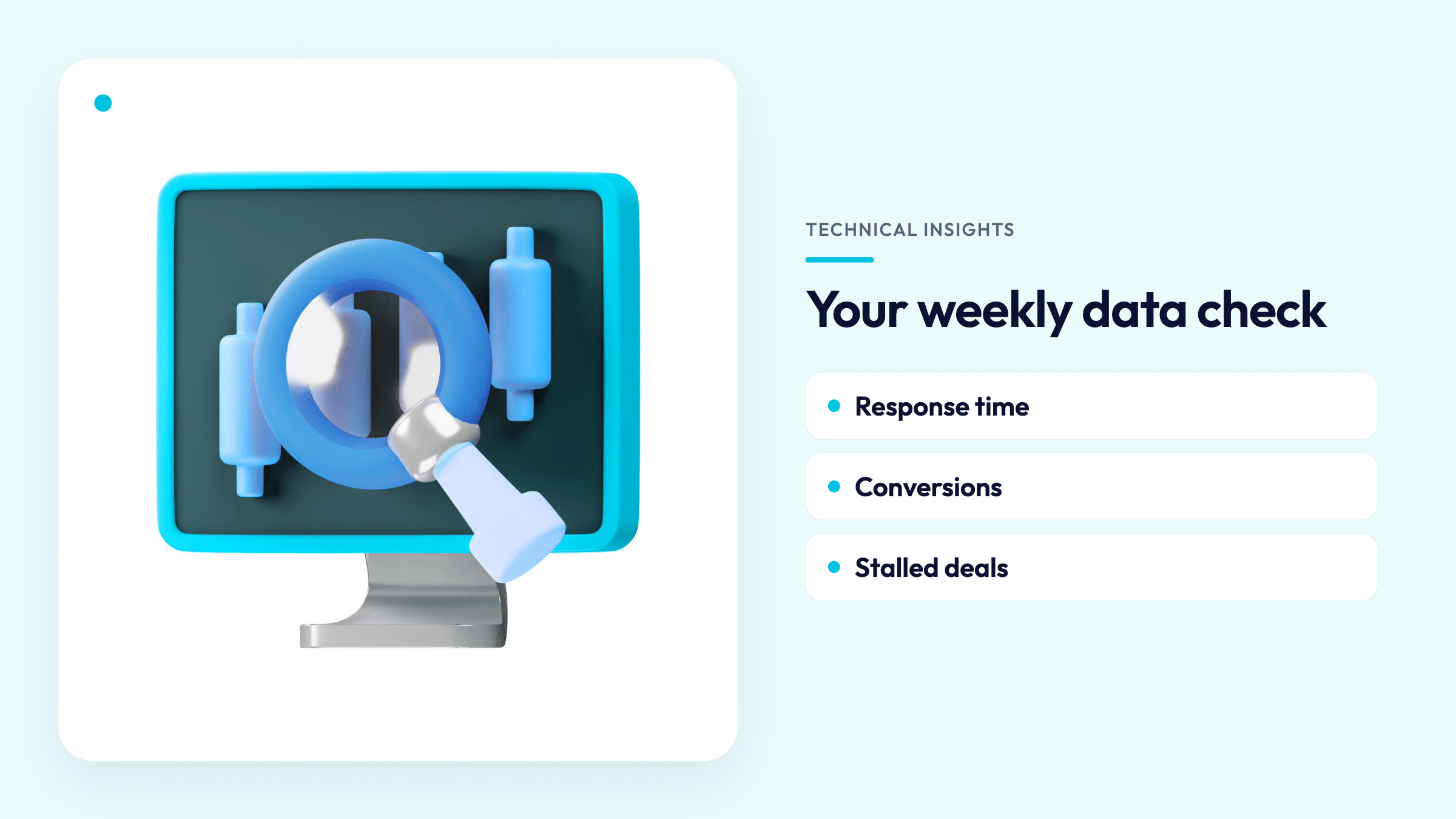
The forecast misses the actual result, and leadership asks why. Usually the CRM data was incomplete and some deals hadn’t been touched in weeks. Technical insights, meaning what the data says about the process itself, are the daily bread of this role. Every week, GTM engineers check:
- Lead response time from form fill to first contact.
- Stage-to-stage conversion across the funnel.
- Opportunities with no activity for 14 days.
- Data quality: records missing basic fields.
- Automation health: whether any workflows have stopped.
These are process health metrics. Sales performance metrics tell you about results: win rate, deal size, cycle length. Weak results with healthy process metrics usually point to an offer problem. Weak results with poor process metrics point to a system problem, and that’s where a GTM engineer can make the biggest difference. It’s worth breaking performance metrics down by segment and lead source, because averages hide the most.
How do GTM engineers approach forecasting? They build a model on sales data: historical conversion rates and actual activity on each deal. A forecast based on activity warns you much earlier that targets are at risk. GTM engineers keep comparing the forecast with the outcome and refine the model.
They design reports that let a sales leader see in five minutes whether the team is on track, where the biggest opportunities sit and which strategies are working this quarter. They also set up alerts: a large deal with no activity for a week gets flagged to the manager, with the threshold tied to the team’s targets.
In this view, sales success means predictability: by mid-quarter, the team knows whether it will hit the number. Growth driven by one big customer looks the same in a report as growth from ten smaller ones. Only breaking the data down shows the risk.
Churn risk and customer success: does a GTM engineer’s job end when the contract is signed?
In a subscription business, the signed contract is where revenue starts. If the customer leaves after six months, you never earn back what it cost to acquire them. That’s why in SaaS companies, GTM engineers also build flows for customer success. The mechanism is the same as in forecasting: sales data from the CRM is combined with product usage data.
Typical churn risk signals:
- a drop in logins and active users;
- a change of decision-maker on the customer side;
- support tickets that stay open too long;
- an upcoming renewal with no contact in recent weeks.
When an account meets several of these conditions, customer success gets a task with full context. Low product adoption in a new account is a signal to go back with onboarding. With data from the GTM engineer, customer success can talk to customers about specifics, and success gets measured by renewals and expansions too.
One person or a GTM Engineering Team: when does a company need a GTM engineer?
The most expensive mistake is hiring a GTM engineer into a company that doesn’t yet have a process worth automating. If nobody knows who the ideal customer is, automation will only speed up the chaos.
Companies usually need GTM engineering in one of three situations:
- The team is growing, but revenue per rep is falling, because time goes into operational work.
- The company is entering a new market and needs to build pipeline fast.
- The stack has sprawled and reports for leadership are built by hand.
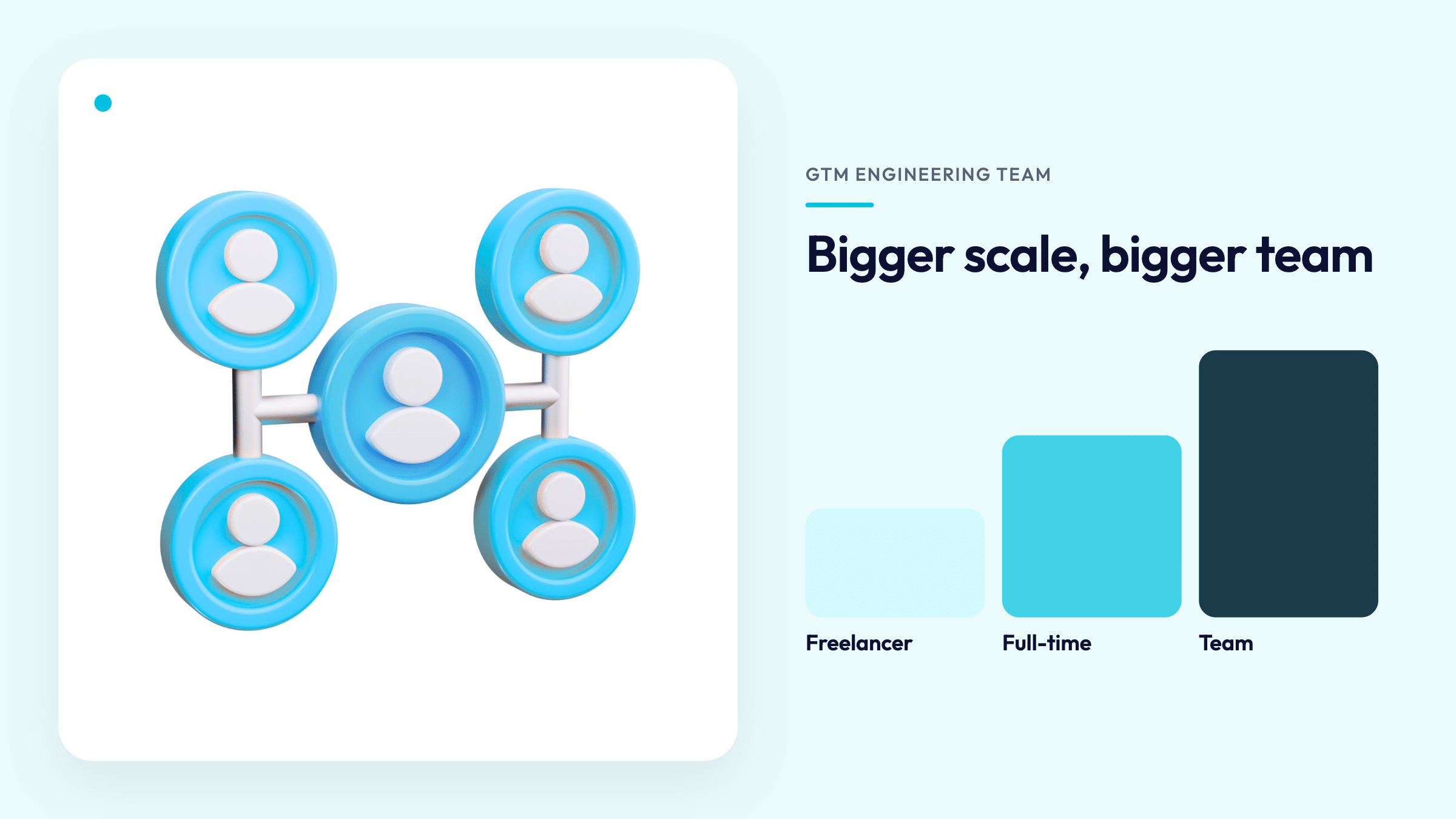
B2B companies selling through several channels at once need it most, and even small teams benefit when their results depend on outbound. There are three models:
- A freelancer on a project: works with a clear scope. A project is a quick way to see whether the model works for you.
- A full-time hire: once there’s enough automation that someone needs to maintain it every day.
- A GTM Engineering Team: when you have several sales teams and markets. Engineers then split the work by area: acquisition, data, analytics.
In every model, the GTM engineer plays a similar role; only the scale changes. In a larger team, engineers are assigned to business lines, so each sales leader has their own engineer for process changes. When the company changes its sales strategy, a GTM engineer can rebuild the flows in a few weeks.
GTM Engineering Capability: what to get in place before you hire
A new GTM engineer often starts by cleaning up the CRM instead of building. You can do part of that work beforehand:
- a written ICP and a way to recognise it in the data;
- stage definitions: when a lead becomes an opportunity;
- a clean CRM with one source of truth;
- the role’s scope and owner: who it reports to and who sets priorities;
- a tool budget.
A good GTM engineer will ask about all of these in the first interview. Once they’re in place, GTM engineers start with quick wins: routing, enrichment, simple scoring. Starting with one big project means waiting months for the first result. Starting small builds a scalable system within a few months.
What happens when a GTM engineer leaves the company?
The GTM engineer leaves, and two weeks later inbound leads stop arriving. Nobody knows why. When a GTM engineer leaves, the company loses the technical knowledge of how its go-to-market actually runs: which integrations depend on each other, where the API keys are, what exceptions were added to the rules. How to protect yourself:
- Document every workflow: what triggers it and where it writes data.
- Company accounts in every tool instead of personal logins.
- A dependency map showing how GTM works across the company.
- A second person with access.
The risk is highest when the GTM engineer works alone, and if they’re a freelancer, documentation should be part of the contract. A good GTM engineer documents their work without being asked, like an architect who leaves the building plans behind. They design flows that others can understand without them and keep a simple change log, because the flows change constantly.
If a GTM engineer leaves good documentation, their successor can start improving the flows instead of reverse-engineering them. Then your go-to-market doesn’t depend on one person, and growth doesn’t stall. A scalable system is a documented one. Without documentation, it’s just fast.
How to become a GTM engineer: skills and first projects
People move into this role from three directions: sales operations, growth marketing, and SDRs who started automating their own work. Each group has half the skill set. A good GTM engineer combines a seller’s thinking with an engineer’s. The skills that matter:
- the sales process: stages, qualification, how SDRs and AEs work;
- the CRM from the inside: objects, fields, automations;
- integrations: APIs, webhooks, Make, Zapier, n8n;
- data: enrichment, deduplication, SQL basics;
- outbound copywriting and AI: personalisation that sounds human.
Most GTM engineers know several CRMs, because every client uses a different one. The easiest way in is to automate your own work first. First projects for your portfolio:
- A signal-based workflow for one segment.
- Lead routing with response time tracking.
- A pre-meeting brief in the CRM.
- A conversion report with alerts for stalled deals.
Each of them shows how you think: from a business problem to a working flow. Present them in your portfolio the way a case study would: problem, solution, result.
Over time, the role develops in one of two directions: toward stack architecture or toward revenue operations leadership. A GTM engineer often becomes the person no campaign launches without, and in an early-stage company, frequently the first technical member of the sales team.
For many people, GTM engineering is also a path into freelancing. Full-time or project-based? Both work, and because the field moves quickly, working with several companies speeds up learning. Freelance GTM engineers often help several companies in parallel, and a common brief is launching outbound from scratch. A typical engagement looks like this:
- audit: reviewing what already works;
- implementation: a test on a small group, adjustments, full rollout;
- handover: documentation and a short training on the new process;
- support after launch.
After launch, adoption is what counts. The GTM engineer explains what changed and why, and when the new process is framed in terms of the reps’ own goals, the team picks it up faster. Some specialise in data and build enrichment infrastructure for many clients; others build outbound infrastructure. After a few projects, you start building systems from ready-made modules rather than from scratch.
Clients pay for outcomes: more opportunities or less manual work. Before you take on a project, ask how their go-to-market is organised today and who owns it. Already have your first workflow in your portfolio? On dealme you’ll find companies looking for a GTM engineer for a specific project.