THE AI LABS CAME TO THE CRM’S HOUSE AND ASKED FOR A ROOM
Benioff puts NVIDIA, Anthropic and OpenAI on his four-layer stack, ElevenLabs sells a $29 receptionist, AI-SDR labs still hire humans to run theirs & Salesforce ships its own model instead of renting
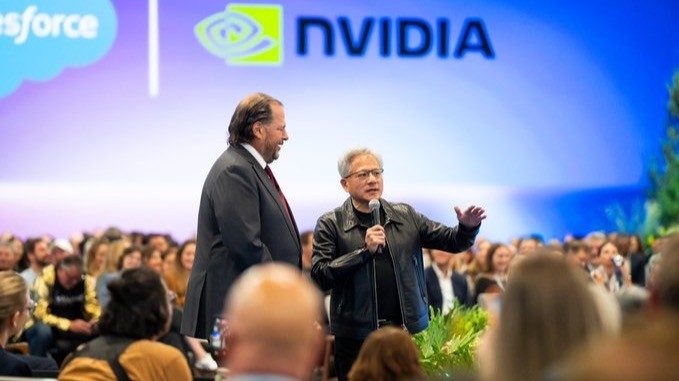
Dario Amodei , Jensen Huang and Sam Altman spoke last week at Dreamforce Not at their own events. At Salesforce ’s.
For two years the story went: the AI labs will eat enterprise software, welcome to the SaaSpocalypse. Last week the labs came to the CRM’s house, and the host spent 108 minutes explaining why they had to. Marc Benioff drew a map: four layers, with the customer’s data at the bottom and a brand-new AI interface on top, and the labs’ models plugged into the middle as one component among several. Then his guests walked on stage and agreed with him.
The same week, ElevenLabs put a receptionist on sale for $29, the labs that built the AI SDR posted more job ads for humans, Salesforce shipped its own reasoning model so it never fully depends on a guest, and Pipedrive handed 100,000 small businesses the same four layers Benioff was selling to the Fortune 500. The CRM stopped being a database. It became the building. Let’s get into the trenches.
Benioff drew the map of enterprise software, and the labs came to find their place on it 🗺️
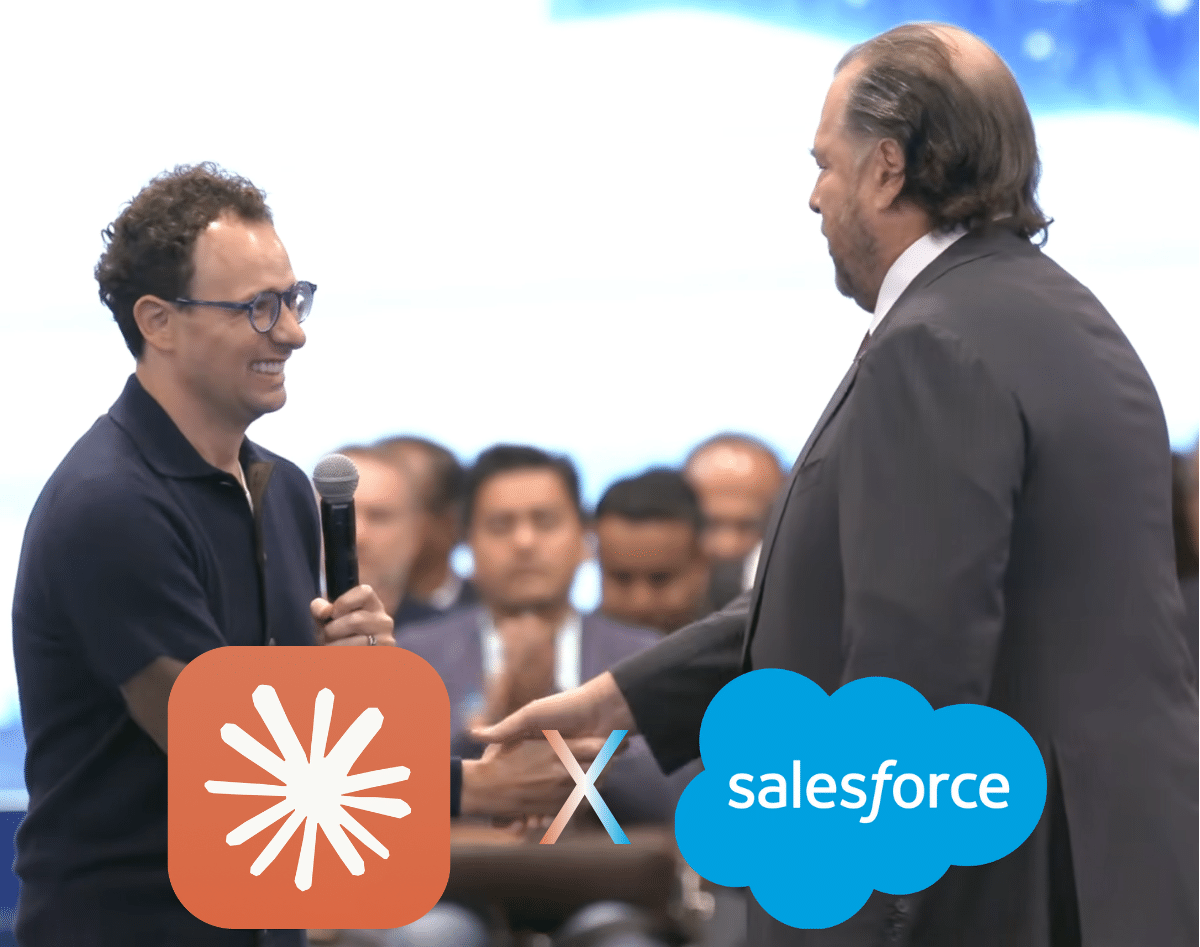
“Models alone cannot run the enterprise.” Said by the CEO who had just embedded Claude in Salesforce, that sentence is the whole thesis of Dreamforce 2026.
Dreamforce is Salesforce’s annual conference in San Francisco: this year 53,000 people on site, 10 million online, 1,600 sessions. Once a year the biggest CRM vendor in the world tells the market what selling will look like for the next twelve months, and when the heads of Anthropic, NVIDIA and OpenAI walk onto that stage, they’re paying a visit to a customer.
Benioff opened with the “crazy nonsense about the SaaSpocalypse” and then said what is actually ending: “the end of software that makes humans do all the work.” Then the numbers: three years at $30 billion, two at $40, “next year we’re entering into the $50 billion.” Lowest attrition in company history, longest contracts in company history. Whatever AI is doing to software, it doesn’t show up in Salesforce’s results.
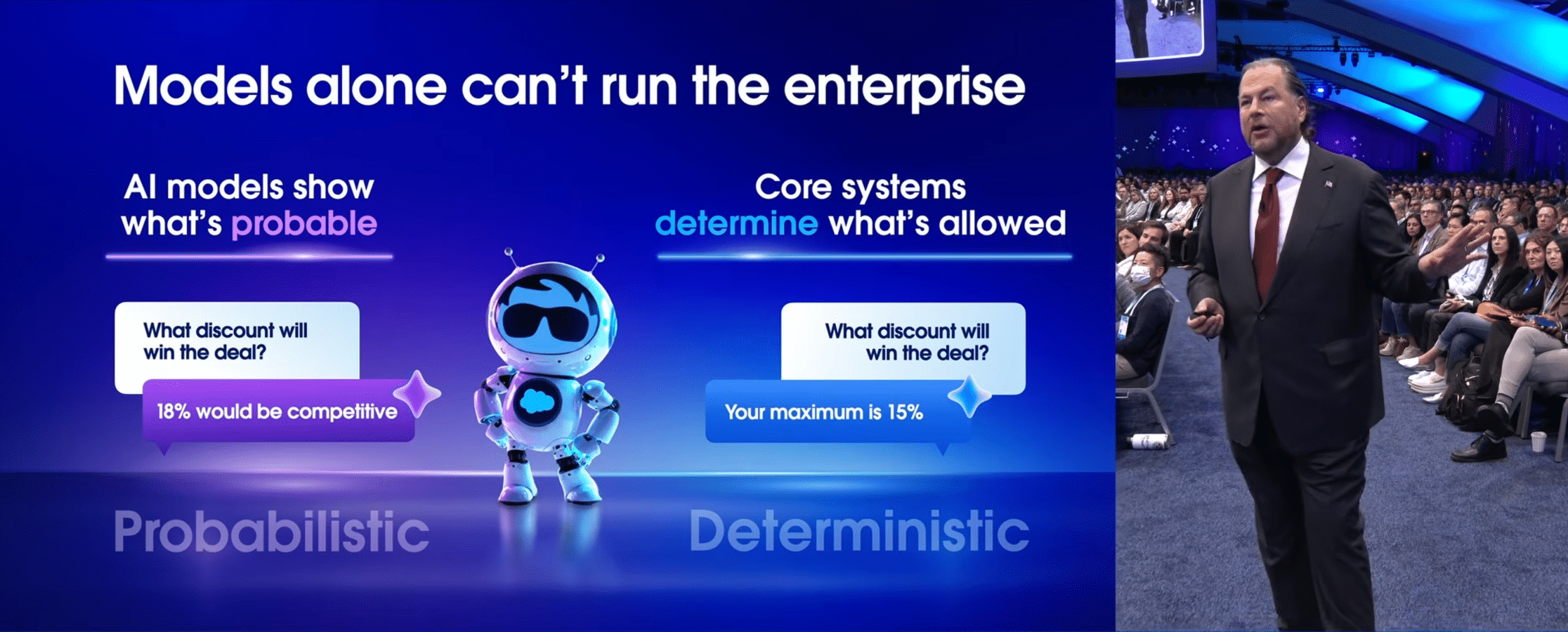
The argument underneath: frontier models know everything about the world, “but they don’t know about your world: your customers, your pipeline, your permissions, your processes.” And they’re probabilistic. A friend of Benioff’s built an app on Claude Cowork: “this number, I know it’s wrong every time”, because “it’s not grounded in your single source of truth.” The enterprise needs to connect probabilistic AI to a deterministic system of truth. Hence the four layers, listed in one breath: “data, apps and semantics, agents, and interface.” Data (Data 360), apps as a metadata layer, agents (Agentforce: 30,000+ customers, 7 billion agent work units) and a new interface, which Benioff called the next revolution in how people use software.
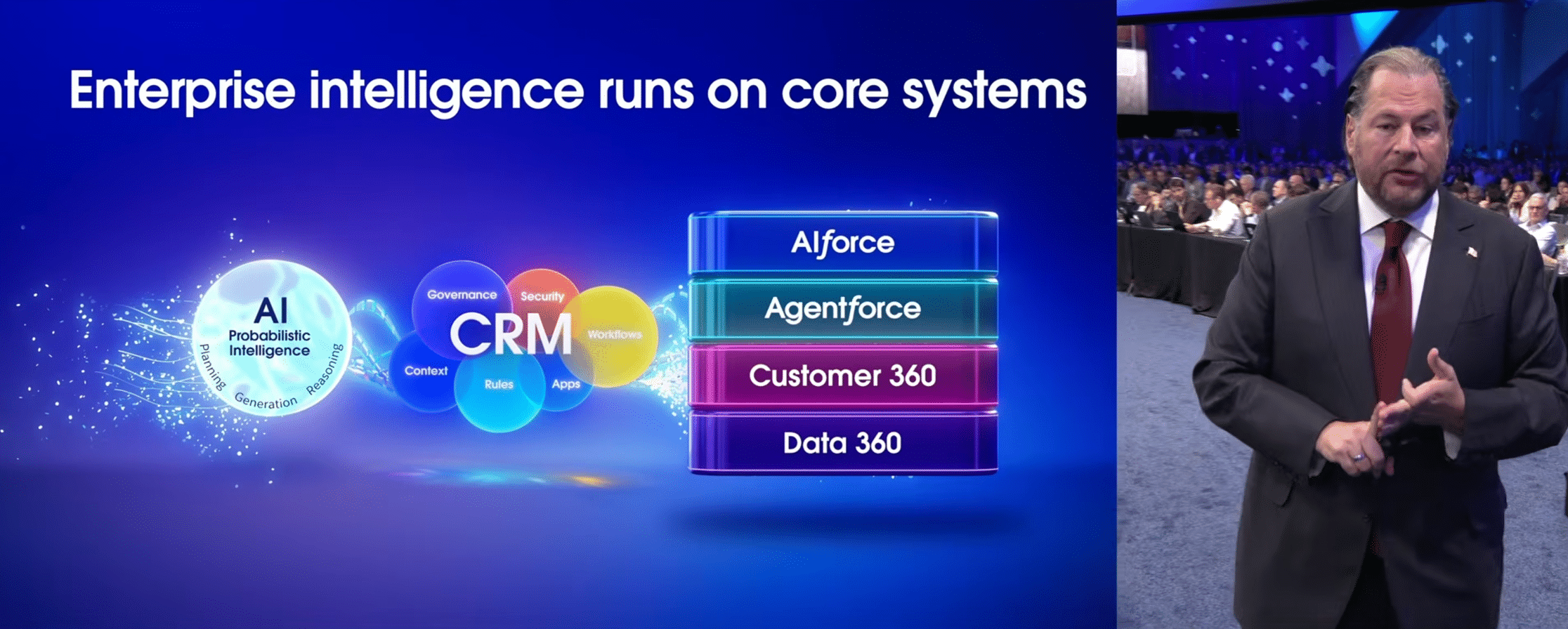
That interface is AI Force: Claudeforce in Cowork, Slackforce in Slack, Agentforce Coworker in Lightning. Parker Harris, the man behind the Lightning UI, in a clip from the stage: “Why should you ever log into Salesforce again? Maybe you never will.” Patrick Stokes explained why a software company can say that: “Other software companies think their product is the UI. At Salesforce, our product is the trust.” Then he showed the command center he built for himself in Claude in “six to eight minutes”: a quarter $8.2 million under target, a $4.8 million deal stuck in security review. The plugin is in open beta on AppExchange.
The guests filled in the rest. Amodei: even if the technology froze today, “we’re making use of maybe only 5% or 10%” of its value, and his own CCO asks Claude in Salesforce every morning for the 10 biggest deals, the 10 most at risk, and how to win them. Jensen: “the end of software is nonsense. This is going to be a layer on top of software.” Altman spoke the same day in a separate session. And one thing Benioff hammered three times: zero data retention. “Your data is your data. It does not go in the models.”
Watch the keynote here:
Damian’s insight:
Distribution is king, context is queen. No GTM tool has better adoption among sellers than the CRM. No system holds more data and more insight about how an organization sells than the CRM. The CRM and the notetaker are the two tools people plug into their Coworks most often. So which tool is the natural candidate to go AI-native in GTM? The CRM, obviously.
Picture sellers having everything we now call GTM engineering inside one app, the one they have known for years, the one where all their customer data already lives. One source of truth, a foundation with AI on top of it. Sure, vibe-coded CRMs will show up, even open-source ones. But if a company’s in-house developers can knock out their own tools this easily, think about what is happening inside the dev teams of the biggest SaaS vendors on earth. They’re only getting started, and they’re cooking inside one ecosystem with years of experience and practice behind it. Distribution is king, context is queen, and the CRM holds both.
ElevenLabs put a receptionist on sale for $29 a month 🎙️
Voice was the last channel that belonged entirely to humans. The best voice company in the world just took the front-desk job at your plumber and your law firm.
In a small business the phone rings while everyone is working. ElevenLabs put it in one sentence in its launch post: answering means “stepping away from the work in front of them, whether that is a plumber on a job, a salon owner with a client, or an IT consultant working through a complex issue.” So the call goes to voicemail, and voicemail is dead. “Most people don’t leave a message,” as Rosie, an AI answering service for small businesses, puts it on its homepage. The caller dials the next number on Google.
Until now you had three options: a receptionist on payroll, a human answering service like Smith.ai ($300 a month for 30 calls), or the first wave of AI receptionists such as Rosie and Goodcall, which proved the demand is real. ElevenLabs walks in with one line: “The most realistic sounding AI receptionist service.” Voice is its layer. The company crossed $500 million in ARR in May, growth it credits to “enterprises deploying voice agents across their businesses, from customer support and sales, to hiring and marketing operations.” Reception is that same platform packaged for a business with no IT department: from $29 a month, with a number, a calendar, a booking page, and a summary, transcript and recording after every call.
Notice what Reception doesn’t do: dial. A stranger will tolerate a bot that answers and hang up on a bot that calls. Notice who funded it: ElevenLabs’ investors include Salesforce Ventures and HubSpot Ventures, so two CRM vendors had a seat at this table before the receptionist existed. And notice how thin the CRM hook is: a calendar and a post-call summary. The first thing every one of these customers will want is for the booked appointment and the call notes to land in a pipeline. Guess who ends up owning that.
Damian’s insight:
Count what a business spends to make that phone ring at all: ads, SEO, the Google listing, reviews, reputation, bought leads. All of it works toward one moment, someone dialing the number. And leads have one problem, and you only need to have answered a few thousand calls to know it: they’re like a hare. They run. Either you handle them now, or ten minutes from now your competitor does.
That’s exactly the problem of ElevenLabs’ target group: small businesses where nobody picks up because everyone is busy doing the work. Bots didn’t help until now, because they lost on response time: long pauses, slow context, the caller hearing silence and hanging up. I tested an AI receptionist and the conversation was comfortable. I’d book with a hairdresser like that. Once the bot clears that bar, every business still sending leads to voicemail is giving them away. Either you handle the lead now, or your competitor will.
“We replaced the sales team with an AI SDR” 📞
Every “we replaced our sales team with an AI SDR” I have heard translates to the same thing: a sequencer, a bought list, and “Hi {prospect name}” going out by the thousand.
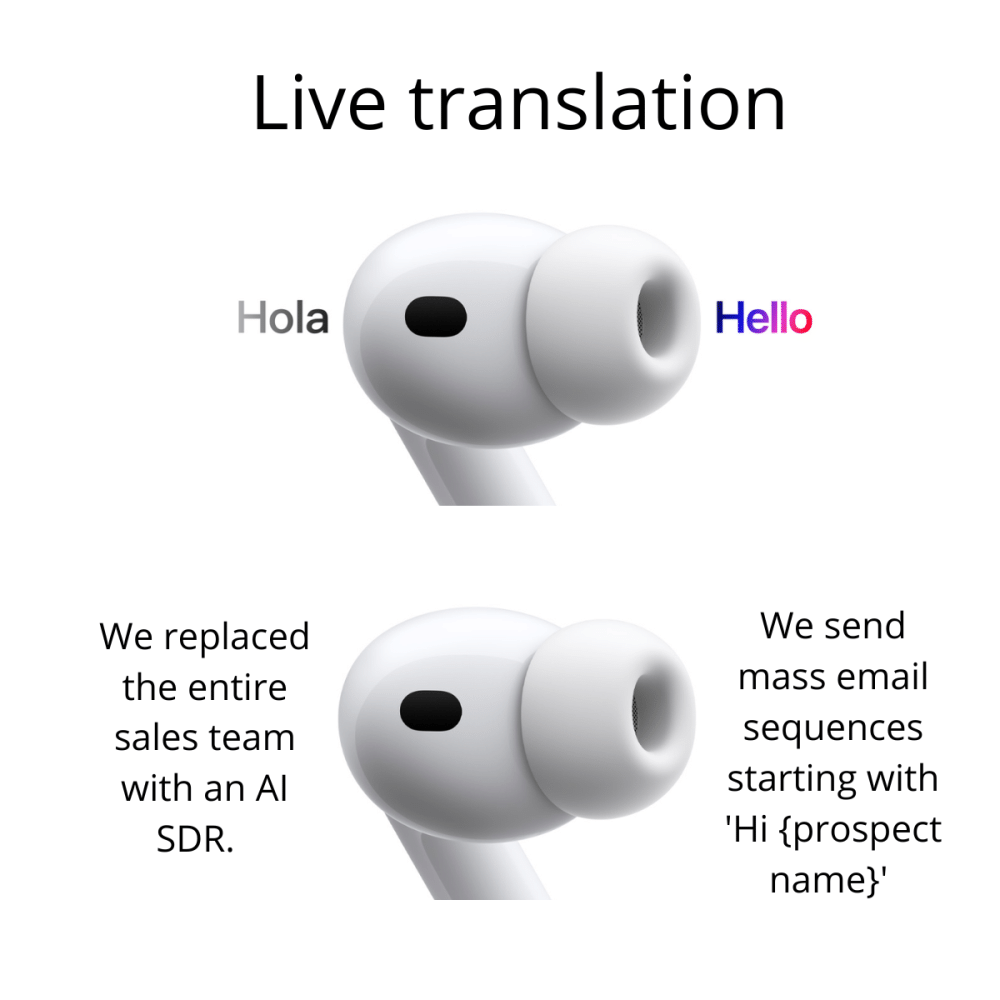
I posted that meme two weeks ago and it did the numbers because every rep who saw it has lived it. So let’s be precise about what got replaced. The part of the SDR job that was already a template. The part where a human pressed send on something no human wrote. That part is gone, and good.
Is this the end of phone sales? I don’t think so. OpenAI ’s careers page lists 816 open roles, about 150 of them in sales and partnerships, including seven “Account Associate” openings at $144–160K base whose description reads “build and iterate on AI-enabled GTM workflows (GPTs/agents) to scale prospecting and qualification.” Anthropic’s careers page shows 122 open sales roles, including Business Development Representatives in San Francisco and New York. The companies that built the AI SDR pay humans six figures to run it.
The agents are real and they’re already on the floor. Siemens announced at Dreamforce that two Agentforce agents, one to engage and one to qualify, now handle 100% of its 2,500+ monthly inbound leads for 18,000 sellers in 132 countries. The machine can send, sort, score, answer and even dial.
What it can’t do is the thing that happens after the prospect picks up. If you’re an SDR who feels behind on the tooling: the tooling is the easy part, and the labs are hiring people to learn it on the job. The bot can answer the phone now. It still can’t make the phone ring, and it still can’t hear the hesitation in “we’re happy with our current vendor.” So build one workflow a week and copy OpenAI’s own spec word for word: GPTs and agents for prospecting and qualification. Get religious about signals, so your calls land on people who have the problem today. And protect the discovery call like it’s your quota, because it is.
See the OpenAI role here! → Click here
Anthropic’s open sales roles → Click here
Damian’s insight: Inbound automates first, because the caller has already decided they want to talk to you. Outbound, the call that creates demand, is still human work, and the labs are hiring for it at $144–160K base. The technology has everything except the one thing you have: you can sell, and you can pick up the phone. Either you sell, or someone else sells to your prospect.
Salesforce just built its own AI model 🚨
The company that just embedded Claude also shipped its own model. Both moves are one strategy.
On September 15 Salesforce announced Koa: its own AI model, built with NVIDIA on NVIDIA’s open Nemotron model. Until now Salesforce built small models for simple tasks and sent the harder reasoning, the multi-step jobs an agent works through step by step, to the frontier models. Jayesh Govindarajan, EVP of Salesforce AI, said it to TechCrunch plainly: “reasoning has always been something that we’ve relied on the frontier model providers for. Until now.” Koa is meant to do what Salesforce customers want an agent to do in sales, marketing and support: answer service questions, book appointments, move a deal through its next steps. And it’s meant to do it better and cheaper than sending the same task to Claude or ChatGPT, because it burns fewer tokens. Salesforce claims that on its own CRM benchmark the model matches or beats the frontier models with three times fewer errors. Their benchmark, so weigh it accordingly.
The training data is the story. Koa never saw a byte of customer data. Salesforce generated synthetic data modeled on what has happened inside its CRM for 27 years. Govindarajan described it simply: they simulated a customer service department, “including irate customers that call into the customer service center, all the way to a sales professional who’s trying to close a deal.” Nobody else has a record like that of how deals and service cases actually move. The model runs inside Salesforce’s security infrastructure and the weights stay with Salesforce. For a CISO, that answers the question “where does our data go”: nowhere. Pilot customers have it now, general availability is winter 2026 in US regions.
The backdrop matters more than the benchmark.
Three weeks before Koa: Claudeforce. Five days before Koa, Salesforce closed the acquisition of Fin, formerly Intercom’s agent (76% average resolution rate, 30,000+ companies), and had it live on help.salesforce.com “in about 12 days.” Rent the frontier for the hardest reasoning, buy the agent that already has distribution, build a specialist model on data only you have. It’s a portfolio, and Jensen Huang described the logic from the stage: closed models are growing fast, but “the open models went from 30% at the beginning of that year to now some 70%”, because “every single software company is an AI company” building its own models. [Crunchbase reference: paste the link you had in mind.]
For you, selling AI into those accounts: your customer’s CRM vendor now ships a model that beats yours on CRM tasks, with no switching cost, inside a boundary the security team has already approved. Walk in with “our model is better” and you have nothing to do there. What’s left is “here’s the revenue this generated in 30 days.”
Read the Koa announcement here!
Damian’s insight:
OpenAI and Anthropic have better models. Salesforce has something they can’t buy: a record of how every deal ever moved through its system, and a seat already installed at the customer. For a seller, Koa lands as a feature inside the ecosystem they already work in, with nothing new to buy. And Benioff keeps stressing one thing: it’s your data. No training the model on your data, the whole thing was built on metadata. And it won’t stay one CEO’s idea. Every CRM vendor with enough history will do the same, because a good-enough model trained on its own workflow data beats a brilliant model that has never seen a pipeline. Sooner or later every organization will have this option. Rent the frontier, own the workflow.
How Anthropic’s CCO runs pipeline: four questions, every morning 🔥
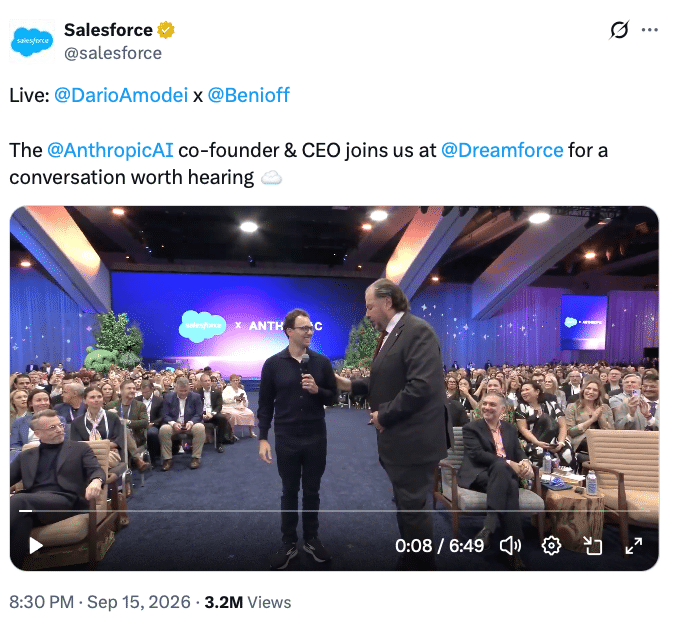
Paul Smith runs the commercial side of Anthropic, the vendor with the largest share of enterprise AI spend, and his pipeline review is four questions typed into Claude every morning.
Dario Amodei told the story on the Dreamforce stage. Smith “still uses Salesforce, but he uses Salesforce with Claude.” Anthropic holds 43.5% of enterprise AI spend by Ramp’s August count, so this is the pipeline of the market leader, and it runs on four questions:
→ What are the 10 biggest deals we’re doing this week? → What are the 10 deals we’re most likely to lose? → What are the themes in those deals? → How do we win those deals?
That’s the whole routine. No custom dashboard, no RevOps ticket for a new report, no Monday spent exporting to a spreadsheet. The data was already in the CRM. What changed is that he can talk to it, “just making use of all the information fluently,” as Amodei put it.
Look at what the questions are about. Every one of them is about deals: where the money is, where it’s leaking, why, and what to do about it. Zero questions about the system, coverage ratios or stage conversion by rep. A CRO with a model in his CRM asks the same questions a good CRO asked in 1998. He just gets the answer in seconds.
Steal it whole. Whatever AI layer sits on your CRM, Claudeforce, Nova, HubSpot’s agents or a Claude MCP connector on Pipedrive, write those four questions down and ask them every morning for two weeks. Then replace your Monday pipeline review with the answers. Amodei’s point was that we use 5 to 10% of what this technology already does. Smith’s routine is what the other 90% looks like: an old habit run on the data you already have.
Damian’s insight:
Amodei says we use 5 to 10% of what this technology can do, and the example he reaches for is a sales leader asking his CRM four questions out loud. That’s the whole AI-native CRM thesis in one routine: the data sat there for years, the missing piece was a way to talk to it. Your Monday pipeline review can be one question instead of four hours in a spreadsheet. Before you buy another tool, ask the one you already have a question.
Pipedrive Nova: SMBs get the same four layers, at no extra cost 🧩
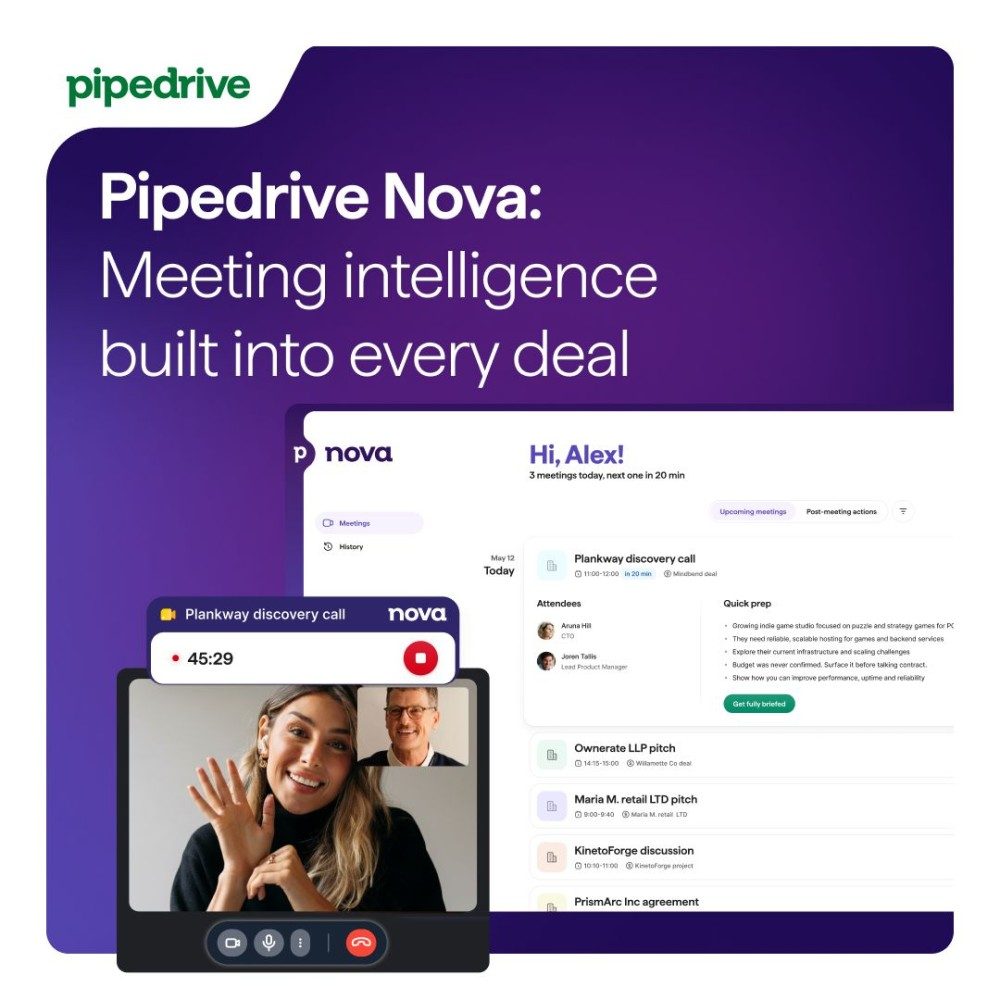
Everything Benioff drew on the Dreamforce stage, Pipedrive just dropped into the CRM that 100,000 companies open every morning.
On September 16 Pipedrive announced Nova: conversation intelligence built into every deal. A brief before the call, focus during it, the CRM updated after. A built-in notetaker and an AI assistant: isn’t that exactly the agent layer Benioff was talking about? Included in every plan, at no additional cost. Put it next to the rest of the Estonian unicorn’s summer: on August 5 it acquired Outfunnel, the highest-rated app on its own marketplace, and on August 18 it shipped an official MCP connector to Claude. A CRM that processes around 100 million deals a year just added the agent layer and the interface layer on top of the data it already had.
Lay it over Benioff’s four floors. The data layer is your Pipedrive records. The semantic layer turns those records into deals, stages, pipelines and activities; that’s the layer Salesforce has been building for 27 years. Nova is the agent layer: it listens, captures and updates. The interface layer is the screen the rep is already looking at. Same architecture as AI Force, without the enterprise buying cycle, the integrator, or a conference with 1,600 sessions.
I’m not writing this from the press release. My team has been in the Nova beta for a few months. What changes is the number of tabs. The rep prepares, runs the call and updates the deal in one place, with no notetaker in a second window, no transcript to paste, no second login. I’ve wanted reps to do their entire job inside the CRM since the day I became a sales manager, and I know no policy will make it happen. What makes it happen is having nowhere else to go. For the first time, that’s close.
The best enterprise-grade software, fully customizable and heavy to move, is a few years ahead, and only the giants can afford to use it to the full (Siemens, which was on the Dreamforce stage too). SMBs can build a similar ecosystem out of a fast-to-configure, simple CRM like Pipedrive, a marketplace of plugins and third-party tools that actually works (the app layer), and MCP plus Nova as the agent layers.
The market is helping.
Miro sold to Bending Spoons on September 10 for $1.36 billion, 92% below its 2021 valuation, with $600 million in ARR and a profit, and TechCrunch’s explanation was that companies “began consolidating duplicate tools and licenses.” Every point solution in your stack is now on the wrong side of that sentence. The CRM isn’t.
That’s where the consolidation lands, whatever the size of the company.
Damian’s insight: The CRM stopped being a database and became the foundation for agents, because agents need three things: clean data, a model of what that data means, and a place to act. The CRM is the only system in a sales org that has all three.
When you buy SaaS you are buying more than a nice AI on top of a table in a database. You are buying a process, years of experience, trial and error, and in the end a proven workflow built around a tool that walks you through it step by step. That’s the whole idea. The only thing changing is who natively spends more time inside it: the human or the AI?
Benioff sells this to companies with 18,000 sellers. Pipedrive just gave it to companies with three, at no extra cost. SMBs gain the most here: they never had a RevOps team, a GTM engineer or a budget for six tools, and now they don’t need any of them. Stop plugging your CRM into AI. Buy the CRM that already is AI.
Found this useful?
Share it so more people do go-to-market seriously, and subscribe to GTM Club for the next drop.