Apollo.io Guide: Features, Pricing & B2B Sales
Apollo.io is a sales intelligence platform that combines a contact database, lead generation capabilities, and sales automation into a single workspace.
In practice, it’s much more than another prospecting tool.
Apollo.io provides sales teams with everything they need to identify potential customers, access contact data, and begin outbound outreach without switching between multiple platforms.
Instead of manually building prospect lists or collecting contact information from different sources, sales representatives can move directly from finding the right prospects to qualifying them and launching outreach campaigns.
One of Apollo.io’s biggest advantages is that it doesn’t stop at providing data.
The platform supports the entire outbound workflow—from prospect discovery and qualification to engagement and ongoing relationship management.
Is Apollo.io a Prospecting Tool or a Sales Intelligence Platform?
Apollo.io is often described as a lead generation platform.
In reality, it functions more like a centralized sales intelligence hub that powers the entire outbound process.
Rather than treating prospect data as static information, Apollo.io continuously supports sales decisions with company insights, contact details, job titles, and other business signals.
That changes the way prospecting works.
Instead of asking:
“Who should we contact?”
Sales teams begin by filtering precise market segments based on clear business criteria.
Data becomes the starting point for every outbound decision.
For many organizations, Apollo.io acts as a layer above the CRM—providing high-quality prospect data that feeds the sales pipeline rather than replacing CRM functionality.
How Apollo.io Works
The core workflow is straightforward.
Apollo.io provides access to a large B2B database that can be filtered using dozens of business attributes, including:
- Industry
- Company size
- Technology stack
- Job titles
- Geographic location
Sales teams can identify prospects, organize them into lists, and begin outreach without leaving the platform.
The biggest operational advantage is speed.
The time between identifying a qualified prospect and sending the first message becomes dramatically shorter.
Instead of moving between multiple applications, the entire process happens in one environment.
For outbound sales organizations, that can significantly accelerate pipeline generation.
However, Apollo.io doesn’t replace strategy.
If a company lacks a clear sales process or Ideal Customer Profile (ICP), the platform simply enables teams to repeat the same mistakes faster.
Lead Generation with Apollo.io
In many organizations, lead generation is fragmented.
Prospect research happens partly on LinkedIn, partly through manual searches, and partly using disconnected databases.
Apollo.io consolidates those activities into a single platform.
Instead of collecting information from multiple sources, sales teams work from one comprehensive database where prospect filtering happens in real time.
Lead generation begins by defining a precise target segment.
Sales teams can filter prospects based on:
- Industry
- Company size
- Location
- Technology stack
- Decision-maker role
That produces prospect lists made up of real buying opportunities rather than generic contacts.
Lead generation doesn’t end with exporting a spreadsheet.
Apollo.io allows users to move immediately into outreach, qualification, and ongoing pipeline management—all within the same workflow.
Lead Generation in Apollo.io: Connecting Marketing and Sales
In many companies, lead generation and sales operate as two separate processes.
Marketing generates contacts.
Sales tries to convert them.
Apollo.io removes that gap by bringing lead generation, prospect qualification, and outbound execution into a single platform.
Instead of receiving a spreadsheet with little context, sales representatives immediately understand:
- Where the lead came from
- Why it matches the Ideal Customer Profile (ICP)
- Whether it’s worth pursuing
That creates an important business advantage.
Sales teams spend less time qualifying poor-fit leads and more time speaking with companies that actually have buying potential.
The result isn’t necessarily more leads.
It’s better leads processed much faster.
If prospects remain untouched for several days after entering the system, the problem isn’t lead volume.
It’s the sales process.
Building a Data-Driven Lead Generation Strategy
Apollo.io’s greatest strength isn’t simply its contact database.
It’s the ability to turn sales data into a repeatable acquisition strategy.
Instead of relying on assumptions, teams can analyze:
- Which industries convert best
- Which company sizes respond most often
- Which segments consistently generate pipeline
Lead generation becomes an operational process rather than a static marketing plan.
Target segments, prospect lists, and filters can all be refined continuously based on measurable performance.
That shortens the time needed to identify successful outbound strategies.
Poor targeting, on the other hand, produces the opposite result.
Large prospect lists generate little engagement, response rates decline, and sales teams spend time contacting companies with little chance of becoming customers.
The solution isn’t more outreach.
It’s better segmentation.
Finding Potential Customers with Apollo.io
Prospect search is one of Apollo.io’s strongest capabilities.
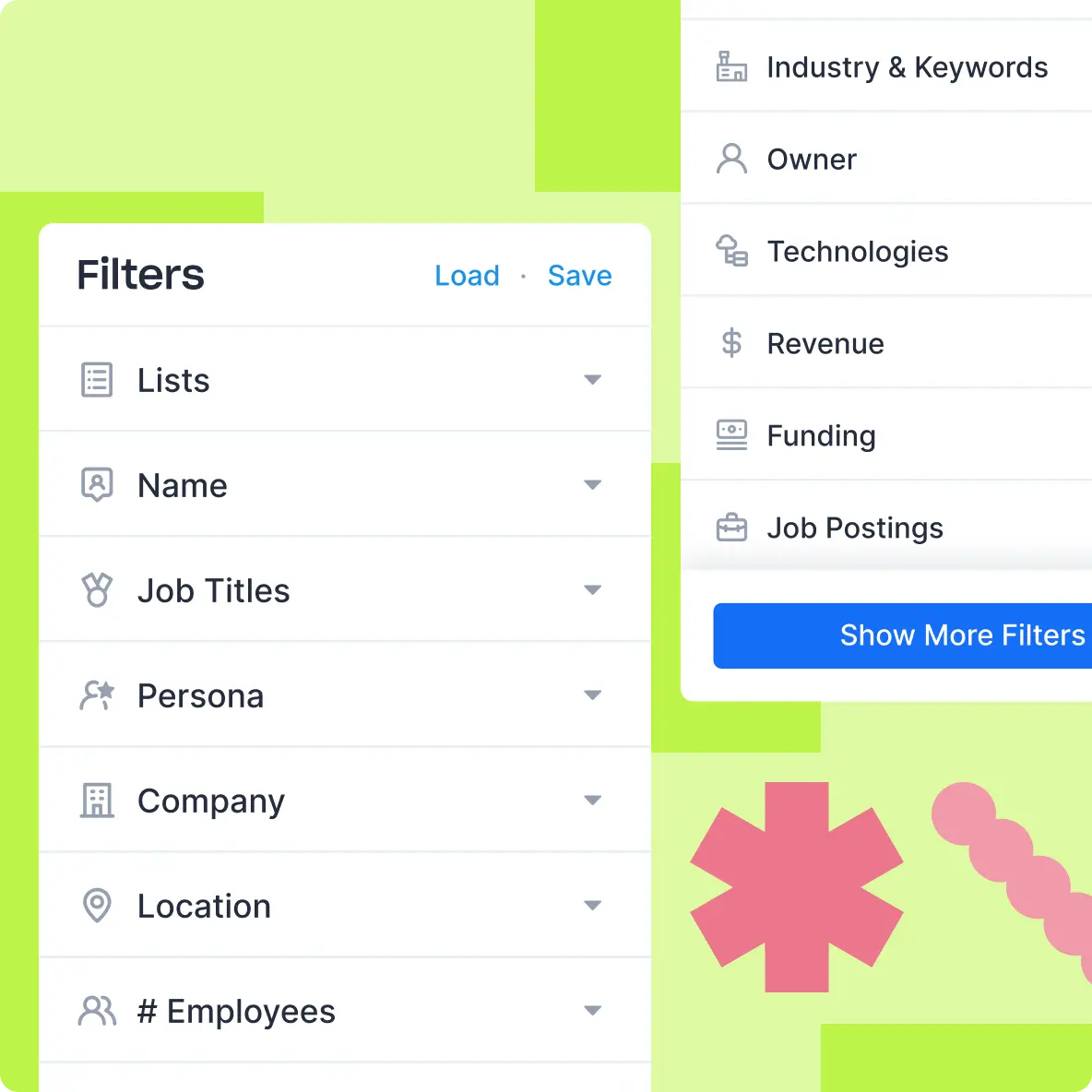
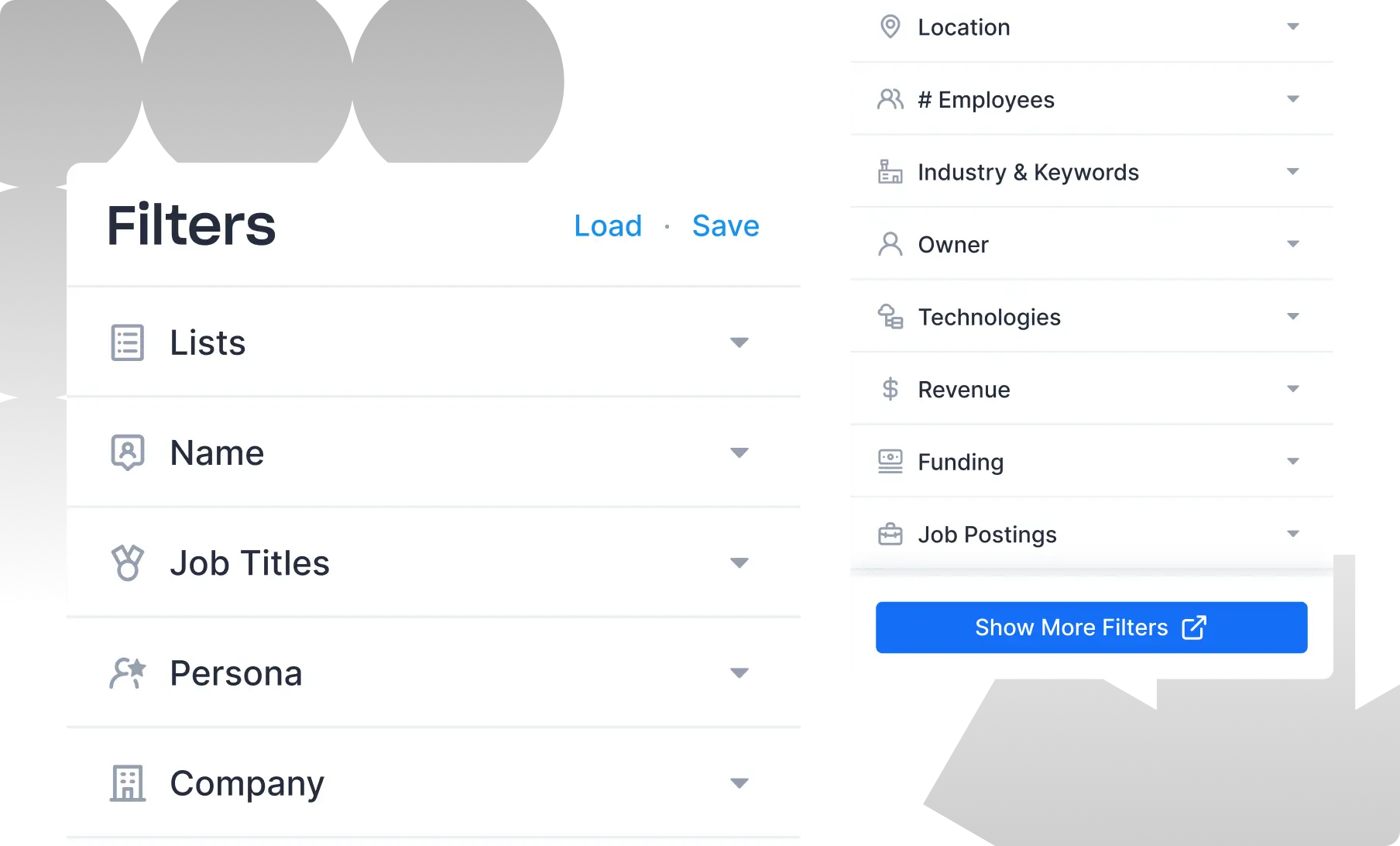
Rather than searching by a single keyword, users can narrow prospect lists using dozens of business filters.
Typical filters include:
- Industry
- Employee count
- Annual revenue
- Technology stack
- Geographic location
Those filters help sales teams identify organizations that closely match their Ideal Customer Profile.
The challenge isn’t finding companies.
It’s finding the right companies.
Broad searches create large databases with low conversion rates.
Overly narrow searches limit outbound scale.
Successful prospecting balances both precision and volume.
Apollo.io Company Database and Contact Database
Apollo.io provides access to a comprehensive business database that combines company information with individual decision-maker profiles.
Rather than working from disconnected spreadsheets, sales teams gain access to:
- Company records
- Contact information
- Job titles
- Decision-maker profiles
- Segmented prospect lists
That dramatically reduces manual research.
Instead of spending hours building prospect lists, sales representatives begin with structured, searchable data.
The platform creates leverage.
The sales team still decides who to target—but much less time is spent collecting information.
Collecting and Verifying Contact Data
One of the biggest bottlenecks in outbound sales is collecting reliable contact information.
Apollo.io automates much of that work by aggregating contact data from multiple sources and verifying it before it’s presented to users.
The objective isn’t perfection.
No database can guarantee 100% accuracy.
Instead, Apollo.io provides significantly better data quality than manual research.
Higher-quality contact information improves:
- Email deliverability
- Outreach efficiency
- Campaign performance
Poor data creates expensive problems.
Sales representatives spend time contacting invalid addresses while email reputation gradually declines.
Better data doesn’t guarantee meetings.
It significantly increases the likelihood that your message actually reaches the intended recipient.
Building High-Quality Prospect Lists
Finding prospects is only the beginning.
Real value comes from building segmented prospect lists that reflect different customer groups.
One of the most common mistakes is launching campaigns using one large prospect list.
A better approach is segmentation.
For example:
- One list for SaaS companies
- Another for manufacturing businesses
- Another for enterprise organizations
- Separate messaging for each customer problem
This approach creates much more relevant outreach.
If one segment underperforms, only that campaign needs adjustment rather than restarting the entire outbound strategy.
Smaller, highly targeted prospect lists almost always outperform large generic databases.
Lead Qualification and Lead Scoring
Generating a large number of leads means very little without a structured qualification process.
That’s why lead scoring is one of the most valuable capabilities in Apollo.io.
The platform allows sales teams to assign priority scores based on criteria such as:
- Company attributes
- Job title
- Buyer behavior
- Engagement signals
This fundamentally changes how sales teams work.
Instead of contacting prospects on a first-come, first-served basis, representatives focus on the opportunities most likely to convert.
Without qualification, pipelines quickly become overloaded with low-priority prospects that consume valuable selling time.
Effective lead scoring shortens the sales cycle while improving conversion rates—without increasing outreach volume.
Tracking Prospect Activity
Apollo.io provides much more than contact information.
It also helps sales teams monitor how prospects interact throughout the sales process.
For example, teams can track:
- Email opens
- Link clicks
- Campaign engagement
- Communication history
These insights make outbound far more dynamic.
Instead of following a rigid sequence, sales representatives can react to real buying signals.
Ignoring prospect engagement is one of the most common reasons outbound campaigns underperform.
When prospects show interest but nobody follows up, valuable opportunities disappear.
Fast responses consistently outperform perfectly written email sequences.
Sales Automation and Outbound Campaigns
For most sales teams, the biggest challenge isn’t finding leads.
It’s finding enough time.
Apollo.io solves much of that problem by automating repetitive sales activities.
Teams can create outbound sequences that automatically manage:
- Email campaigns
- Follow-up messages
- Reminders
- Prospect workflows
Automation saves time—but it doesn’t replace strategy.
Poor messaging sent automatically simply scales poor results.
Successful automation depends on:
- Strong segmentation
- Relevant messaging
- Clear campaign objectives
Without those elements, automation only accelerates ineffective outreach.
Managing Automated Campaigns
Apollo.io allows teams to automate far more than email delivery.
Campaigns can react dynamically to prospect behavior.
For example, workflows can automatically:
- Stop when a prospect replies
- Assign leads to sales representatives
- Trigger different follow-up sequences
- Update prospect status
That reduces manual administration and allows sales teams to focus on conversations rather than repetitive operational tasks.
As outbound volume grows, this level of automation becomes increasingly important.
Without structured campaign management, communication quickly becomes inconsistent and difficult to scale.
Personalization at Scale
One of the biggest outbound mistakes is treating every prospect exactly the same.
Apollo.io makes personalization much easier by combining prospect data with automated outreach.
Sales teams can tailor messaging using information such as:
- Industry
- Job title
- Company characteristics
- Business context
That changes the quality of outbound significantly.
Instead of sending generic sales emails, teams create messages that feel relevant to the recipient’s current situation.
The business impact is measurable.
Better personalization typically leads to:
- Higher open rates
- More replies
- Faster meetings
Even the largest contact database delivers poor results if every prospect receives the same generic message.
Apollo.io CRM Integration
One of Apollo.io’s biggest strengths is its ability to integrate with CRM platforms.
Prospecting and pipeline management become part of one connected workflow instead of separate processes.
Rather than manually transferring information between systems, lead data flows directly into the CRM after the first interaction.
That means sales representatives spend less time on administration and more time selling.
Without CRM integration, businesses often experience:
- Duplicate records
- Lost prospect information
- Manual data entry
- Slower sales execution
Well-designed integrations transform disconnected tools into a unified sales system.
CRM Synchronization and Data Management
Connecting Apollo.io to a CRM is only the first step.
The real challenge is maintaining synchronized, accurate data.
Apollo.io supports two-way synchronization, allowing updates made in either system to remain consistent across both platforms.
This becomes especially important for larger sales organizations.
Without clear ownership of customer data, multiple representatives may unknowingly work with outdated information, duplicate contacts, or conflicting deal statuses.
Successful CRM integration requires more than technology.
It requires clear operational rules defining:
- Where customer data is managed
- Who updates records
- Which platform serves as the single source of truth
Without that governance, even the best integration eventually creates operational chaos.
Is Apollo.io a CRM or a Sales Intelligence Platform?
One of the most common questions is whether Apollo.io can replace a CRM.
Technically, it offers some CRM-like functionality.
In practice, however, it shouldn’t be viewed as a full customer relationship management system.
Apollo.io works best as a layer above the CRM.
It supplies prospect data, supports outbound activities, and automates the earliest stages of customer engagement.
Managing active opportunities, sales pipelines, deal stages, and long-term customer relationships should still happen inside a dedicated CRM.
The strongest sales workflows combine both systems.
Apollo.io generates and qualifies opportunities.
The CRM manages them through the rest of the sales cycle.
Without clearly defined responsibilities for each platform, sales teams often create duplicate work and lose visibility into pipeline performance.
Lead and Contact Management in One Platform
One of the biggest operational challenges in B2B sales is fragmented customer information.
Some contacts live inside email inboxes.
Others remain in spreadsheets.
The rest sit inside the CRM.
Apollo.io brings those early-stage sales activities into one workspace.
Sales teams can:
- Organize leads
- Manage contact records
- Track outreach status
- Monitor follow-up activities
Instead of manually checking where every prospect stands, representatives immediately see which leads require action.
That significantly improves sales efficiency.
Technology alone, however, isn’t enough.
Without a structured sales process, even centralized lead management becomes difficult to scale.
Customer Database Management
Customer data changes constantly.
People change jobs.
Companies restructure.
Decision-makers move into new roles.
A contact database only creates value when it’s continuously updated.
Apollo.io regularly refreshes customer information, allowing sales teams to work with more accurate records than traditional static databases.
Managing customer data becomes an ongoing process rather than a one-time task.
Keeping prospect information current improves:
- Email deliverability
- Sales efficiency
- Pipeline quality
Working from outdated information slows every stage of outbound sales.
Managing Sales Data Effectively
Having access to customer information isn’t enough.
Sales teams also need immediate access to that information at the right moment.
Apollo.io reduces time spent switching between platforms by keeping prospect data available throughout the sales workflow.
That allows representatives to move from research to outreach much faster.
At the same time, sales organizations should avoid treating the database as an unquestionable source of truth.
Even high-quality data requires ongoing validation and thoughtful segmentation.
When databases are used strategically rather than indiscriminately, they become a genuine competitive advantage.
Sales Analytics and Performance Measurement
Many sales teams still evaluate outbound campaigns using only basic metrics such as email volume or reply counts.
Apollo.io provides much deeper visibility into campaign performance.
Teams can analyze metrics such as:
- Open rates
- Reply rates
- Campaign performance
- Segment performance
These aren’t vanity metrics.
They directly influence sales decisions.
When one customer segment consistently outperforms another, sales teams can adjust targeting immediately rather than waiting months to recognize the pattern.
Without data analysis, outbound becomes guesswork.
With continuous measurement, sales becomes an iterative process that improves over time.
A Centralized Sales Intelligence Hub
Apollo.io functions as a central hub for sales intelligence.
Prospecting activity, campaigns, customer engagement, and outreach performance all flow into one platform.
That changes how sales decisions are made.
Instead of relying on instinct, teams work with measurable evidence.
For example, they can quickly identify:
- Which customer segments convert best
- Which outreach messages generate replies
- Where prospects leave the sales pipeline
Data itself doesn’t improve sales.
Using that data to refine targeting, messaging, and process does.
Organizations that consistently analyze performance shorten the time required to improve outbound campaigns while making sales results far more predictable.
Apollo.io Pricing: Which Plan Should You Choose?
For many companies, one of the first questions is:
How much does Apollo.io cost—and is it worth the investment?
Apollo.io offers several pricing tiers, with Basic and Professional being the plans most businesses compare.
Basic includes the core functionality needed to begin outbound prospecting, including contact search, limited prospect credits, and basic outreach capabilities.
Professional expands those limits while adding more advanced automation, analytics, and CRM integration.
The decision shouldn’t be based on subscription cost alone.
It should be based on outbound volume.
For teams running occasional prospecting campaigns, Basic is often sufficient.
Organizations building a repeatable outbound engine usually benefit far more from Professional, where additional automation and reporting help improve efficiency at scale.
Choosing a plan that’s too limited can slow sales execution long before it reduces software costs.
Is Apollo.io GDPR Compliant?
Questions about GDPR and data privacy appear in almost every discussion about Apollo.io.
The answer isn’t simply whether Apollo.io is compliant.
The more important question is whether your sales process complies with applicable data protection regulations.
Apollo.io aggregates publicly available business contact information from multiple sources.
Using that information responsibly remains the responsibility of the organization running outbound campaigns.
From a GDPR perspective, businesses should carefully consider:
- Their legal basis for processing data
- The relevance of outreach
- Clear opt-out mechanisms for recipients
Poorly targeted mass outreach creates unnecessary legal and commercial risk.
Relevant, personalized communication aimed at legitimate business interests presents a much stronger compliance position.
The platform doesn’t make campaigns compliant.
Your process does.
Is Apollo.io Legal to Use?
Rather than asking whether Apollo.io is legal, companies should ask whether their outbound strategy follows applicable regulations.
The software provides access to business data.
It doesn’t determine how that data is used.
Common compliance risks include:
- Untargeted mass email campaigns
- Missing unsubscribe options
- Outreach without relevant business context
Organizations that build segmented, value-driven outbound campaigns generally reduce both legal and commercial risk.
Ignoring compliance, however, can quickly undermine even the strongest sales strategy.
Customer Support and Onboarding
Given the platform’s broad functionality, customer support plays an important role in successful implementation.
Apollo.io provides resources including:
- Product documentation
- Technical support
- Educational materials
- Onboarding guidance
Support helps users understand how the platform works.
It doesn’t replace sales strategy.
Companies expecting Apollo.io to generate pipeline automatically often become disappointed regardless of how responsive support may be.
The platform succeeds when internal sales processes are already in place.
Customer Support Experience
For experienced outbound teams, support primarily accelerates implementation and resolves technical questions.
Teams with strong internal sales knowledge typically require little assistance beyond documentation and occasional troubleshooting.
Customer reviews tend to follow a similar pattern.
Organizations with established outbound processes usually report significant value.
Companies hoping for a plug-and-play sales solution often struggle because Apollo.io requires thoughtful implementation rather than simple activation.
The platform rewards operational maturity.
It doesn’t replace it.
Key Apollo.io Features
Apollo.io includes a wide range of functionality, but only a handful of features consistently influence sales performance.
The most valuable capabilities include:
- Prospect database
- Advanced prospect search
- Outbound campaign management
- Sales automation
- CRM integration
Individually, each feature provides incremental value.
Combined, they create a much more efficient outbound sales workflow.
Focusing only on contact data without automation limits scalability.
Automating campaigns without high-quality prospect data reduces campaign quality.
The greatest business impact comes from using these capabilities together rather than independently.
Lead Generation and Sales Automation
Apollo.io delivers the greatest value where two capabilities come together: lead generation and sales automation.
Within a single platform, sales teams can:
- Build targeted prospect lists
- Launch outbound campaigns
- Automate follow-ups
- Manage ongoing outreach
That removes the need to switch constantly between prospecting tools, email platforms, and spreadsheets.
Sales automation shouldn’t be viewed as an optional feature.
For growing outbound teams, it becomes the standard way to maintain consistency while increasing scale.
Manual outreach limits growth.
Automation without strategy reduces quality.
Apollo.io provides the tools to balance both.
When supported by a structured sales process, automation helps teams move faster while maintaining consistent execution.
Chrome Extension and Everyday Sales Work
One of Apollo.io’s most practical features is its Chrome Extension.
Instead of switching back to the platform every time they identify a potential customer, sales representatives can work directly from websites such as LinkedIn.
From the browser they can:
- View prospect information
- Save new leads
- Add contacts to campaigns
- Continue working without breaking their workflow
That significantly reduces friction during prospecting.
Because less time is spent navigating between tools, sales representatives can focus on higher-value activities.
The extension is also relatively easy to adopt, making onboarding much smoother for new team members.
Small workflow improvements like these often have a meaningful impact on overall outbound productivity.
The Biggest Advantages of Apollo.io
Apollo.io combines several capabilities that are usually spread across multiple sales tools.
Its strongest advantages include:
- Access to a large B2B contact database
- Continuously updated prospect information
- Built-in outbound automation
- CRM integration
- Faster prospecting workflows
Together, these capabilities help sales teams build pipeline more efficiently while reducing manual administrative work.
However, Apollo.io creates the most value only when it’s integrated into an existing outbound process.
Organizations without outbound sales or without the capacity to follow up on generated leads often struggle to justify the investment.
Technology accelerates execution.
It doesn’t replace strategy.
Is Apollo.io the Right Tool for Your Sales Strategy?
The most important question isn’t whether Apollo.io is a good platform.
It’s whether it matches your sales model.
Apollo.io performs exceptionally well for organizations that rely on outbound prospecting and data-driven sales.
Companies experimenting with outbound without a defined process often see disappointing results—not because of the platform, but because the fundamentals aren’t yet in place.
Before implementing Apollo.io, businesses should ask themselves three questions:
- Do we have a clearly defined Ideal Customer Profile (ICP)?
- Do we have a repeatable outbound sales process?
- Can our sales team manage the lead volume we generate?
If the answer to those questions is yes, Apollo.io becomes a powerful growth accelerator.
If not, strengthening the sales process should come first.
Our Apollo.io Review
From an operational perspective, Apollo.io is one of the strongest outbound sales platforms currently available.
Its greatest strengths include:
- Reducing the time needed to identify qualified prospects
- Improving targeting accuracy
- Making outbound testing significantly faster
Its biggest weaknesses appear when companies expect software alone to solve sales problems.
Poor targeting, weak messaging, and a lack of strategy remain problems regardless of which platform is used.
Apollo.io provides better data and better execution capabilities.
It doesn’t replace thoughtful sales leadership.
Conclusion: Should You Use Apollo.io for B2B Sales?
Apollo.io can dramatically accelerate outbound sales—but only when it’s built on solid foundations.
Companies with a defined sales strategy, clear customer segmentation, and a structured outbound process can use Apollo.io to build pipeline faster while maintaining consistency as they scale.
Organizations lacking those fundamentals often discover that Apollo.io simply exposes existing weaknesses more quickly.
The decision is ultimately straightforward.
If you’re ready to build outbound sales around data, automation, and repeatable processes, Apollo.io is a valuable addition to your sales stack.
If not, focus on strengthening your sales process before investing in additional technology.